


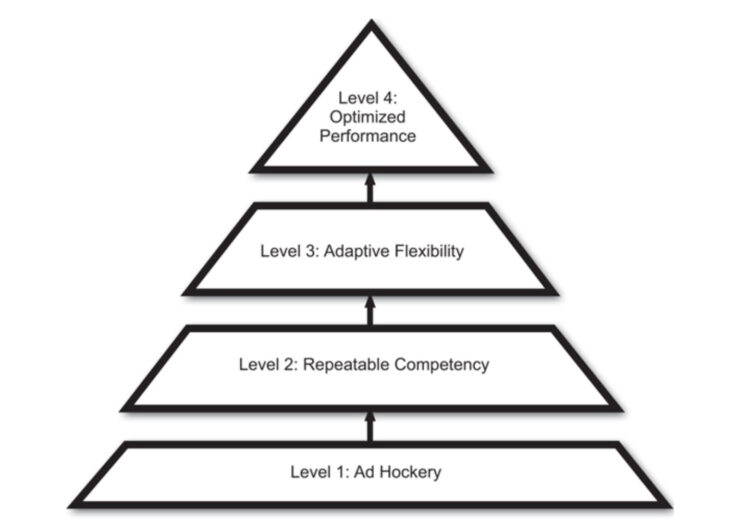
Sports organizations systematically approach player development and game planning yet treat negotiations as individual heroics. The Negotiation Capability Model provides a framework for building from reactive “Ad Hockery” through repeatable competency to optimized partnership-based excellence, creating sustainable competitive advantage through systematic negotiation maturity.
Executive Summary
The Problem: Most sports organizations operate in negotiation “Ad Hockery,” treating each negotiation as a unique crisis requiring individual heroics rather than systematic competency.
The Framework: The Negotiation Capability Model (NCM) defines four maturity levels from reactive approaches through repeatable processes to optimized partnership excellence.
The Solution: Sequential development through maturity levels, starting with repeatable competency to build foundations for adaptive flexibility and eventual partnership optimization.
The paradox of modern sports management reveals itself most clearly in negotiation practices. Organizations that meticulously systematize player development programs, implement sophisticated analytics platforms, and optimize performance through scientific methodology abandon all systematic thinking when approaching negotiations. Each contract discussion, facility deal, or sponsorship arrangement becomes an exercise in improvisation rather than institutional capability.
This inconsistency extends beyond operational inefficiency to strategic vulnerability. In an ecosystem where single negotiations determine competitive windows, financial trajectories, and organizational reputation, treating negotiation as artisanal craft rather than engineered competency represents fundamental strategic failure. The stakes—measured in hundreds of millions of dollars, decade-long commitments, and championship opportunities—demand systematic excellence rather than occasional brilliance.
This analysis presents the Negotiation Capability Model, a framework for understanding and developing organizational negotiation maturity. The discussion proceeds in three parts: first, diagnosing the current state of negotiation chaos plaguing sports organizations; second, examining the four maturity levels that define the progression toward excellence; and finally, outlining implementation strategies for systematic capability development.
Understanding the Challenge: The Ad Hockery Epidemic
Level 1 of the Negotiation Capability Model, termed “Ad Hockery,” describes the reactive, unstructured negotiation approaches that characterize most sports organizations. This state manifests not through lack of talent or effort but through absence of systematic frameworks that enable consistent excellence. Organizations operating in Ad Hockery treat each negotiation as unprecedented, relying on individual heroics rather than institutional capabilities to achieve outcomes.1
The symptoms of Ad Hockery permeate sports negotiations at every level. Contract discussions begin weeks before expiration rather than through strategic planning cycles. Success depends entirely on whoever leads the negotiation, with institutional knowledge evaporating when key personnel depart. Preparation consists of hasty comparable gathering rather than systematic stakeholder analysis. Measurement relies on subjective post-negotiation debriefs rather than objective performance metrics. These patterns repeat across player contracts, media rights, facility agreements, and sponsorship deals, creating unpredictable outcomes that undermine strategic planning.2
The tactical focus that characterizes Ad Hockery generates particular vulnerabilities in sports contexts. Negotiators concentrate on immediate deal terms—compensation, duration, specific clauses—without considering broader strategic implications. Teams might “win” contract negotiations while creating salary cap constraints that preclude future roster construction. Organizations might secure favorable facility terms while damaging political relationships essential for long-term success. Short-term victories achieved through Ad Hockery often produce long-term strategic defeats.
The persistence of Ad Hockery despite its obvious limitations reflects organizational blind spots about negotiation as a capability. Sports organizations that would never tolerate random approaches to player development or game preparation accept negotiation chaos as inevitable. This acceptance stems from misconceptions that negotiation success depends on innate talent rather than systematic development, that each situation is too unique for standardized approaches, or that formal processes constrain creativity. These beliefs perpetuate cycles of unpredictable outcomes, damaged relationships, and missed opportunities.
Case Illustration: The Free Agency Crisis Pattern
A professional basketball team operating in Ad Hockery approached their star player’s contract extension three weeks before free agency. Without systematic preparation or strategic alignment, negotiations devolved into positional bargaining over maximum salary demands. The rushed process damaged relationships, leaked to media creating public pressure, and ultimately resulted in the player’s departure—not over money, but due to process frustrations that systematic approaches would have prevented.
Framework Analysis: The Four Maturity Levels
Level 2, Repeatable Competency, represents the foundational transformation from chaos to consistency. Organizations at this level establish systematic approaches that produce predictable results across different negotiators and situations. Strategic alignment ensures every negotiation serves organizational objectives. Preparation follows standardized processes including market analysis, stakeholder mapping, and option development. Clear roles and authority eliminate confusion about decision-making. Measurement systems track both outcomes and process quality, enabling continuous improvement. These foundations create institutional memory that survives personnel changes while establishing baselines for further development.3
Level 3, Adaptive Flexibility, builds sophisticated capability for contextual optimization while maintaining systematic foundations. Organizations at this maturity level modify standard processes based on specific circumstances—long-term partners receive different approaches than new counterparts, strategic negotiations warrant deeper preparation than routine renewals. Negotiation strategies adapt to counterpart styles, constraints, and objectives rather than applying uniform approaches. Creative problem-solving transcends industry conventions when standard structures encounter obstacles. Rapid learning integration ensures lessons from each negotiation enhance organizational capability. This level represents mastery of both negotiation science and art.4
Level 4, Optimized Performance, transcends traditional negotiation paradigms through genuine partnership approaches. Organizations at this pinnacle collaborate with counterparts to design negotiation processes that maximize value creation rather than simply claiming existing value. Information sharing shifts from strategic withholding to transparent exchange that enables better decisions by all parties. Joint process design ensures negotiation approaches serve everyone’s interests. Focus moves from dividing current resources to expanding possibilities through creative collaboration. These approaches require exceptional trust and competence but generate outcomes impossible through traditional adversarial methods.
The progression through maturity levels follows necessary sequences that cannot be circumvented. Organizations cannot leap from Ad Hockery directly to Adaptive Flexibility because adaptation requires stable foundations that don’t exist at Level 1. Similarly, partnership approaches at Level 4 demand demonstrated competence and trustworthiness established through consistent performance at lower levels. Each level builds upon previous capabilities rather than replacing them—Level 4 organizations still employ systematic preparation and adaptive approaches, adding partnership elements when appropriate. This cumulative development creates compounding advantages as capabilities reinforce each other.5
Negotiation Capability Model Components
Level 1 – Ad Hockery: Reactive, unstructured approaches producing unpredictable results. Success depends on individual heroics, preparation is minimal, and learning is anecdotal.
Level 2 – Repeatable Competency: Systematic processes generating consistent outcomes. Strategic alignment, standardized preparation, clear roles, and measurement systems create institutional capability.
Level 3 – Adaptive Flexibility: Sophisticated contextual optimization. Standard processes modified for specific situations, counterpart analysis, creative problem-solving, and rapid learning integration.
Level 4 – Optimized Performance: Partnership-based value creation. Joint process design, transparent information sharing, collaborative problem-solving, and long-term relationship orientation.
“Negotiation maturity isn’t about being nice or avoiding difficult conversations. It’s about being strategically sophisticated enough to achieve your objectives consistently while building the relationships and reputation that create long-term organizational success.”
— Joshua A. Gordon, Strategic Negotiation: Building Organizational Excellence
Implementation Strategy: Building Maturity Systematically
Most sports organizations should initially focus on achieving Level 2 Repeatable Competency across critical negotiation functions. This pragmatic approach recognizes that foundational capabilities must exist before sophisticated adaptations become possible. The transition from Ad Hockery to Repeatable Competency generates immediate improvements in outcome predictability, relationship quality, and organizational learning while establishing platforms for future advancement. Organizations attempting to implement advanced techniques without basic foundations typically revert to Ad Hockery when pressure intensifies.6
Implementation begins with honest assessment of current negotiation practices across different organizational functions. Systematic evaluation tools identify where Ad Hockery dominates and which functions would benefit most from capability development. Player contract negotiations might operate at Level 2 while sponsorship discussions remain in Ad Hockery. Facility negotiations might show Level 3 sophistication while media rights discussions lack systematic approaches. This diagnostic mapping enables targeted development rather than generic training programs that fail to address specific organizational needs.
Priority functions—those most critical to organizational success or most frequently executed—receive initial development focus. For professional teams, this typically includes player contracts, coaching agreements, and key vendor relationships. For leagues, priority areas might encompass collective bargaining, media rights, and sponsor partnerships. Systematic development in these areas involves creating preparation templates, establishing decision authorities, implementing review processes, and building measurement systems. Initial implementations should be simple enough to ensure adoption while comprehensive enough to demonstrate value.
Continuous learning mechanisms transform individual negotiations into organizational capability development. Post-negotiation reviews examine not just outcomes but process execution, identifying what worked, what didn’t, and why. Lessons learned feed into updated procedures, refined templates, and enhanced training. Cross-functional sharing ensures insights from one negotiation domain inform others. This learning infrastructure differentiates organizations that continuously improve from those that repeat the same patterns regardless of results. Over time, accumulated learning creates competitive advantages that cannot be quickly replicated by competitors.7
Implementation Phases
Phase 1: Diagnostic Assessment
Systematically evaluate current negotiation practices across organizational functions using maturity model criteria. Identify gap areas, prioritize development needs, and establish baseline metrics for improvement tracking.
Phase 2: Foundation Building
Implement Level 2 capabilities in priority negotiation functions through standardized preparation processes, role clarification, authority definition, and basic measurement systems that create repeatable competency.
Phase 3: Capability Expansion
Develop Level 3 adaptive capabilities through counterpart analysis training, creative problem-solving workshops, and rapid learning integration systems while expanding Level 2 competencies to additional negotiation domains.
Practical Implications
For Athletic Administrators:
Recognize negotiation capability as strategic infrastructure requiring systematic development rather than hoping for individual brilliance. Allocate resources for process development, training, and continuous improvement. Establish clear expectations that negotiations follow systematic approaches rather than Ad Hockery. Create accountability systems that reward process excellence alongside outcome achievement, understanding that good processes generate better long-term results.
For Athletes and Representatives:
Evaluate organizational negotiation maturity when considering career decisions. Organizations operating at higher maturity levels typically create better outcomes for all parties through systematic preparation and creative problem-solving. Engage constructively in systematic negotiation processes rather than demanding Ad Hockery approaches. Recognize that structured negotiations often produce better outcomes than chaotic last-minute discussions.
For Legal Practitioners:
Support clients in developing systematic negotiation capabilities rather than simply executing individual deals. Help establish decision-making frameworks, authority structures, and review processes that enable consistent excellence. Document negotiation processes and outcomes to build institutional memory. Advocate for investment in negotiation capability development as essential infrastructure for long-term organizational success.
Conclusion
The journey from negotiation Ad Hockery to systematic excellence represents fundamental transformation in organizational capability. Sports organizations that develop negotiation maturity gain sustainable competitive advantages through predictable excellence, relationship capital, strategic flexibility, and continuous learning. These advantages compound over time, creating widening gaps between organizations that invest in systematic capability development and those that perpetuate chaotic approaches.
Implementation requires strategic patience and sustained commitment. Building negotiation maturity demands cultural change, process discipline, and investment in capabilities that may not generate immediate visible returns. Organizations must resist reverting to Ad Hockery when pressure intensifies or when individual negotiations become challenging. The temptation to abandon systematic approaches for heroic improvisation must be countered by leadership commitment to capability development.
The competitive dynamics of modern sports make negotiation excellence increasingly critical for organizational success. As player mobility increases, media landscapes fragment, and stakeholder expectations escalate, the ability to consistently execute complex negotiations becomes differentiating capability. Organizations that systematically develop from Ad Hockery through repeatable competency toward adaptive excellence position themselves for sustained success in increasingly complex negotiation environments.
Sources
1 Joshua A. Gordon & Gary Furlong, STRATEGIC NEGOTIATION: BUILDING ORGANIZATIONAL EXCELLENCE 45-78 (Routledge 2023).
2 Joshua A. Gordon, Gary Furlong & Ken Pendleton, THE SPORTS PLAYBOOK: BUILDING TEAMS THAT OUTPERFORM YEAR AFTER YEAR 156-189 (Routledge 2018).
3 Danny Ertel & Mark Gordon, THE POINT OF THE DEAL: HOW TO NEGOTIATE WHEN YES IS NOT ENOUGH 89-112 (Harvard Business Review Press 2007).
4 Hal Movius & Lawrence Susskind, BUILT TO WIN: CREATING A WORLD-CLASS NEGOTIATING ORGANIZATION 134-158 (Harvard Business Review Press 2009).
5 Roger Fisher, William Ury & Bruce Patton, GETTING TO YES: NEGOTIATING AGREEMENT WITHOUT GIVING IN 97-106 (3d ed. Penguin Books 2011).
6 David Lax & James Sebenius, 3-D NEGOTIATION: POWERFUL TOOLS TO CHANGE THE GAME IN YOUR MOST IMPORTANT DEALS 45-72 (Harvard Business Review Press 2006).
7 Michael Wheeler, THE ART OF NEGOTIATION: HOW TO IMPROVISE AGREEMENT IN A CHAOTIC WORLD 178-195 (Simon & Schuster 2013).
Note: All citations follow Bluebook format. For questions about specific citations, consult The Bluebook: A Uniform System of Citation (21st ed. 2020).
About the Author
Joshua A. Gordon serves as Woodard Family Foundation Fellow and Professor of Practice of Sports Business & Law as well as the Faculty Athletics Representative at the University of Oregon and Senior Practitioner at the Sports Conflict Institute. Read full bio →
Transform Your Negotiation Capability
Move from Ad Hockery to systematic excellence with expert guidance
Related Resources
Strategic Negotiation
Build organizational excellence through systematic negotiation capability
Learn More →The Sports Playbook
Create winning teams through culture, character, and clarity
Discover the Framework →