


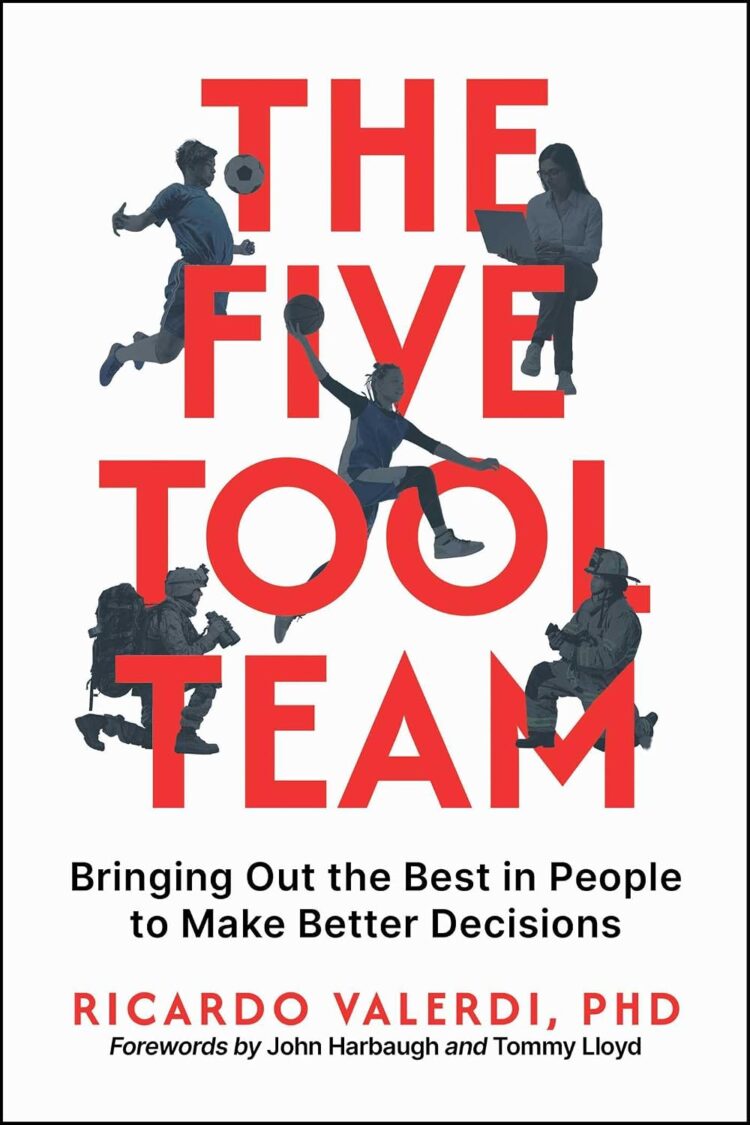
Sport and its institutions reward outcomes while neglecting the skill that produces them: decision-making itself. Drawing on Dr. Ricardo Valerdi’s FLASH framework, this analysis separates decision quality from outcome quality and offers a method for building teams that decide well under uncertainty, pressure, and incomplete information.
Executive Summary
The Challenge: Organizations in sport and beyond judge decisions almost entirely by their outcomes, leaving the underlying skill of decision-making untrained and diffusing accountability across committees until no one truly owns the call.
The Framework: Valerdi’s FLASH model—Focus, Look, Analyze, Scrutinize, Humanize—treats decision-making as a set of coachable fundamentals and separates the quality of a decision from the outcome it happens to produce.
The Solution: Shift from the five-tool player to the five-tool team by staffing for decision coverage rather than raw intelligence, installing a defensible process, and ensuring a named leader owns each consequential decision.
A decision and its outcome are not the same thing. We know this instinctively, then forget it the moment the scoreboard lights up. A sound process can produce a loss, and a reckless one can back into a win. Yet organizations routinely grade the decision by the result, rewarding luck and punishing rigor. That confusion is why so few institutions ever get better at the one activity that determines their future.
I sat down for SCI TV with Dr. Ricardo Valerdi—engineer, sports scientist, professor and Faculty Athletics Representative at the University of Arizona, and an advisor to organizations ranging from SpaceX to the U.S. Army to Major League Baseball and the NCAA—to discuss his new book, The Five-Tool Team. Our lives first intersected through NCAA and faculty athletics work, and that shared vantage point on collegiate governance runs through the entire conversation.
This analysis examines why decision-making has become the unattended fundamental in sport, business, and governance. The discussion proceeds in three parts: why the fixation on outcomes leaves the underlying skill untaught; how the FLASH framework restores decision quality as a discipline; and how leaders convert individual competence into a five-tool team.
Watch the full conversation on SCI TV.
Understanding the Challenge: The Unattended Fundamental
Valerdi opens his book with John Wooden teaching future Hall of Famers how to put on their socks. The point is not footwear. It is that mastery rests on fundamentals executed so reliably they become invisible, and that great programs never stop drilling them. His argument is that most organizations have quietly dropped one fundamental from the practice plan: decision-making itself. We coach shooting form and conditioning, but treat the capacity to decide well as something leaders either possess or do not, rather than a skill that can be taught, measured, and improved.1
The root cause is an overemphasis on outcomes. People want to know what happened—did the stock rise, did the merger close, did the trade work—and infer the quality of the decision straight from the result. Decision analysts call this trap “resulting,” and it is dangerous precisely because it is intuitive. When everything works out, no one interrogates the process or the decision-maker; the organization congratulates itself and learns nothing. A good outcome becomes a license to repeat a flawed method until the variance finally turns.2
The structural version of this problem is the diffusion of accountability. Valerdi recalled hearing that a governing body had stood up a dedicated “decision-making group” and admitted he laughed—shouldn’t that be everyone’s job? Layers, committees, and working groups can be genuine attempts at rigor, but they frequently accomplish the opposite: they make it impossible to identify who actually decided and who is answerable. Structures designed to spread responsibility end up ensuring no one holds it. At the end of any consequential process, someone still has to raise a hand and say, “I own this.”
The cost of leaving this fundamental unattended is caution masquerading as prudence. When decisions are graded only on outcomes and ownership is blurred, the rational move for any individual is the least accountable path—defer, study further, form another committee. Bold, defensible decisions require the opposite: a process sound enough that a leader can stand behind the choice regardless of how the result breaks. Without it, institutions do not merely decide poorly; they lose the ability to decide at all.
Case Illustration: The Right Answer for the Wrong Reason
At a science exhibit built around a notoriously difficult final puzzle that had gone unsolved for months, a teenager fiddling with the controls happened onto the correct answer. Smoke rose, the crowd turned to admire his brilliance—and it was pure luck. As a grown adult he could never solve it again. The lesson is uncomfortable: a celebrated outcome can conceal the absence of any repeatable method beneath it.
Framework Analysis: Separating the Decision From the Outcome
The first principle Valerdi insists upon is the one most people fly past: we control the quality of our decisions, not their outcomes. We can gather the right people, run the analysis, wait until the last responsible moment, and still lose, because outcomes answer to forces beyond our reach. The corollary is equally hard to accept: a careless decision can produce a fine result. Judging quality by outcome gives a false read in both directions. The discipline is to evaluate a decision when it is made, on the process available then, and resist the retrospective distortion the result imposes.3
FLASH names what those fundamentals actually are: Focus on the right questions, Look at the data from multiple perspectives, Analyze the consequences of your options, Scrutinize the alternatives, and Humanize the process. Humanize is the load-bearing tool for this moment. However much data exists and whichever model sits at your fingertips, a human being makes the call that affects other human beings—and no leader gets to say the algorithm told them to do it. Deciding is a forecast and a creative act, demanding judgment about where signal ends and noise begins. That cannot be outsourced.
A second distinction sharpens the framework: the logic of consequences versus the logic of appropriateness. The first asks which option yields the best expected result. The second asks what a person in your role, bound by its duties, ought to do—independent of the odds. Mature decision-making holds both. When the probabilities point one way and the obligations of the role point another, the leader who can only calculate consequences erodes the credibility that makes future leadership possible. The appropriate choice protects the institution across the long run of decisions, not just the one in front of you.4
Finally, Valerdi asks a question few decision-makers pause to answer: what game are you playing? Deterministic environments reward skill with predictable, linear cause and effect. Stochastic environments are governed by uncertainty and large swings, where the best you can do is put the probabilities in your favor and accept that you do not control the result. Most of us operate in the stochastic world without realizing it. Collegiate sport—reshaped by name, image, and likeness, the transfer portal, and the House settlement—is profoundly stochastic, yet we keep trying to manage it with deterministic rules. Knowing which game you are in is the precondition for deciding well within it.
The FLASH Framework: Five Tools for Better Decisions
Focus on the right questions: Define the actual problem before chasing answers; a precise question prevents a well-executed solution to the wrong issue.
Look at the data from multiple perspectives: Interrogate evidence from more than one angle, especially where it contradicts intuition or a preferred conclusion.
Analyze the consequences: Project options forward through their second- and third-order effects, including the unintended ones.
Scrutinize the options: Pressure-test alternatives against one another rather than defending the first acceptable choice.
Humanize the process: Own the call as a human being accountable to other human beings; use analysis and AI as inputs, never as the decider.
“Decisions should not be judged on the basis of their outcomes.”
— Ronald A. Howard, founder of the field of decision analysis
Case Illustration: Coach Candrea at the Airport
En route to the Women’s College World Series, legendary Arizona softball coach and Olympic medalist Mike Candrea faced a decision at the departure gate when his All-American ace arrived very late, breaking a firm team rule. Consequences argued for taking his best pitcher; appropriateness argued for the rule and the credibility it protected. He sent her home. Valerdi withholds the tournament result on purpose—knowing it would corrupt the judgment of whether the decision was sound.
Implementation Strategy: From Five-Tool Player to Five-Tool Team
The pivotal move is in the title: it is the five-tool team, not the five-tool player. Demanding that one person master all five tools places impossible pressure on any individual and misreads how consequential decisions actually get made—rarely in isolation. The practical implication is a reframed hiring question. As Valerdi puts it, do not hire for intelligence; hire for decision coverage. Assess which of the five tools your current team executes well, identify the gaps, and recruit deliberately to fill them, the way a general manager builds a roster rather than collecting stars.
Coverage can be probed in the interview room. Ask a candidate to describe a significant decision and how they made it, and listen for process rather than outcome; a compelling result reached by guesswork reveals a gap, not a strength. Valerdi also revives a question from a well-known management essay—”Why should anyone be led by you?”—as a diagnostic. A strong answer surfaces quickly: because I am a good decision-maker, and I can help others become good decision-makers too. That is precisely the disposition a five-tool team is built to cultivate.5
Ownership must also be located correctly, which means understanding what committees are for. Committees do not make decisions; they make recommendations. When Arizona weighed adding a new women’s sport, Valerdi’s first question was whether the committee was a genuine deliberative body or a symbolic exercise ratifying a choice already made. It was genuine: it weighed economics, scholarships, and geography, recommended women’s triathlon, and forwarded that to the president and athletic director, who owned the decision. A rigorous, well-evidenced process does not dilute accountability; it makes it easier for the accountable party to own the call with confidence.
The failure mode to engineer against is agreement no one actually wants. The Abilene Paradox—a family miserably driving across Texas to a lunch not one of them desired, each going along to please the others—captures how groups manufacture consensus that serves no member. The antidote is not the tired notion that a good resolution leaves everyone equally unhappy. It is disciplined inquiry into what each party actually needs, as in the classic negotiation of two cooks fighting over one orange until someone asks why: one wants the juice, the other the zest. Surface the interests and the false trade-off dissolves.6
Implementation Phases
Phase 1: Separate Decisions From Outcomes
Build the habit of grading the process, not the result. Document the reasoning behind consequential choices at the time they are made, so quality can be assessed independent of how the variance ultimately breaks.
Phase 2: Install the FLASH Discipline
Make the five tools an explicit checklist for significant decisions—right question, multiple perspectives, consequence analysis, scrutinized options, and a human owner—rather than a reflex performed haphazardly under time pressure.
Phase 3: Staff for Decision Coverage
Audit your team against the five tools, hire and develop to close the gaps, and clarify for every consequential decision who recommends and who owns—so accountability is designed in rather than diffused away.
Practical Implications
For Athletic Administrators and Governance Leaders:
Treat your governance environment as stochastic and stop pretending deterministic rules will tame it. Before convening any working group, establish whether it decides or merely recommends, and name who owns the outcome. Evaluate leaders on the quality of their process, especially when results disappoint, or you will train your organization to prize luck and avoid accountability.
For Coaches and Team Leaders:
Coach decision-making as a fundamental, the way you coach technique. When appropriateness and consequences diverge, recognize that honoring the standard often protects the credibility on which future performance depends. Do not let a single bad bounce redefine a sound season, and do not let a lucky one excuse a broken process.
For Conflict Resolution Practitioners:
Guard against manufactured agreement by surfacing the interests beneath stated positions—the juice and the zest behind the contested orange. Help groups distinguish the decision from its outcome so that a disappointing result does not reopen a sound settlement, and build processes that let the accountable party own the resolution with confidence.
Conclusion
Valerdi’s contribution is to take an activity everyone performs and no one practices and return it to the status of a fundamental. Once decision quality is separated from outcome, the FLASH tools become teachable, and the honest question shifts from “did it work?” to “was it a sound decision given what we knew?” That standard is more demanding and fairer. It rewards rigor over luck and gives leaders ground to make bold choices they can defend regardless of how the result breaks.
The implementation is modest in scale and serious in effect. Document reasoning at the moment of decision. Run consequential choices through the five tools rather than through habit. Staff for coverage across the tools rather than for a single brilliant generalist. Fix, for every meaningful decision, who recommends and who owns. None of this requires new technology; each step requires the discipline to treat deciding as a craft rather than an instinct.
This is where Valerdi’s engineering and SCI’s conflict work meet. Sound process does not guarantee good outcomes, but over a long enough run it produces them—and it builds the credibility, trust, and accountability that let teams keep deciding well under pressure. In a landscape defined by uncertainty and noise, the organizations that thrive will be those that stop worshiping outcomes and start, quietly and relentlessly, putting their socks on properly.
Sources
1 Joshua A. Gordon & Gary Furlong, Strategic Negotiation: Building Organizational Excellence (Routledge 2023).
2 Joshua A. Gordon, Gary Furlong & Ken Pendleton, The Sports Playbook: Building Teams That Outperform Year After Year (Routledge 2018).
3 Ricardo Valerdi, The Five-Tool Team: Bringing Out the Best in People to Make Better Decisions (Regalo Press 2026).
4 Ronald A. Howard & Ali E. Abbas, Foundations of Decision Analysis (Pearson 2015).
5 James G. March, A Primer on Decision Making: How Decisions Happen (Free Press 1994).
6 Rob Goffee & Gareth Jones, Why Should Anyone Be Led by You?, Harv. Bus. Rev., Sept.-Oct. 2000, at 62.
7 Jerry B. Harvey, The Abilene Paradox: The Management of Agreement, Organizational Dynamics, Summer 1974, at 63.
Note: Interview with Dr. Ricardo Valerdi conducted for SCI TV. All citations follow Bluebook format. For questions about specific citations, consult The Bluebook: A Uniform System of Citation (21st ed. 2020).
About the Author
Joshua A. Gordon, JD, MA is the founder of the Sports Conflict Institute and a neutral arbitrator and mediator for the Court of Arbitration for Sport, FIFA, and Major League Baseball, as well as Professor of Practice and Faculty Athletics Representative at the University of Oregon. Read full bio →
Build a Team That Decides Well Under Pressure
SCI helps athletic departments, leagues, and organizations design decision-making and conflict-resolution systems that hold up when the stakes are highest.
Related Resources
Strategic Negotiation
Build organizational excellence through systematic negotiation capability
Learn More →The Sports Playbook
Create winning teams through culture, character, and clarity
Discover the Framework →SCI TV
In-depth interviews exploring conflict, negotiation, and decision-making in sport
Watch More Episodes →Podcast: Play in new window | Download
Subscribe: Apple Podcasts | Amazon Music | Android | iHeartRadio | RSS