Category Archives: Blog

Unlocking Performance Through Diagnosis in Sport

Sports organizations frequently implement solutions without understanding root causes, creating costly malpractice. This analysis presents diagnostic frameworks that transform reactive interventions into strategic improvements through systematic assessment, data-informed clarity, and evidence-based decision-making that addresses systemic challenges rather than symptoms.

Sports Conflict Institute
15 min read
Categories: Organizational Assessment | Performance Diagnosis | Sports Leadership

Executive Summary

The Problem: Sports organizations implement costly interventions without understanding root causes, creating cycles of ineffective solutions.

The Framework: Systematic diagnosis through behavioral profiling, cultural assessment, and stakeholder analysis reveals true performance barriers.

The Solution: Evidence-based assessment creates targeted interventions that address systemic challenges, building sustainable competitive advantages.

In sport, urgency is constant. From locker rooms to boardrooms, decision-makers face relentless pressure to resolve tensions, implement strategies, and restructure cultures immediately. This urgency drives leaders toward rapid interventions, quick fixes, and decisive actions that appear to demonstrate leadership strength. Yet without understanding root causes, any action becomes mere reaction, often exacerbating the very problems organizations seek to solve.

Prescription without diagnosis constitutes organizational malpractice, yet this pattern pervades sports at every level. Conflict, misalignment, and underperformance rarely stem from single moments or individuals. They emerge from systemic issues, often invisible to casual observation, yet entirely addressable through rigorous assessment. The difference between sustainable success and recurring failure lies not in the speed of intervention but in the precision of diagnosis.

This analysis examines systematic diagnosis in sports organizations, presenting frameworks for transforming reactive management into strategic excellence. The discussion proceeds in three parts: first, understanding why diagnosis failures perpetuate organizational dysfunction; second, exploring comprehensive assessment methodologies; and finally, implementing diagnostic systems that create sustainable competitive advantages through evidence-based decision-making.

Understanding the Challenge: The Rush to Solution Without Diagnosis

Sports organizations operate under unique pressures that drive premature intervention. Season calendars create artificial deadlines for problem resolution. Media scrutiny amplifies every conflict into crisis. Fan expectations demand immediate responses to poor performance.1 These pressures combine to create environments where leaders feel compelled to act decisively, even when they lack understanding of underlying issues driving organizational challenges.

The consequences of prescription without diagnosis manifest across multiple organizational levels. Teams implement new offensive systems without understanding why previous approaches failed. Athletic departments restructure reporting relationships without identifying communication breakdowns. Organizations invest millions in culture initiatives without assessing existing cultural dynamics.2 Each intervention appears logical in isolation yet fails to address root causes, creating expensive cycles of failed solutions.

Common diagnostic failures follow predictable patterns. Surface-level analysis mistakes symptoms for causes, leading organizations to address visible problems while ignoring underlying dysfunction. Confirmation bias leads leaders to seek evidence supporting predetermined solutions rather than conducting objective assessment. Time pressure truncates investigation, forcing decisions based on incomplete information. Political considerations suppress uncomfortable truths that comprehensive diagnosis might reveal about leadership failures or systemic issues.

The cumulative impact extends beyond individual failures to organizational culture. When interventions repeatedly fail, cynicism develops among stakeholders who recognize the pattern of ineffective solutions. Trust erodes as employees experience constant change without improvement. Resources deplete through repeated investments in unsuccessful initiatives. Eventually, organizations develop learned helplessness, accepting dysfunction as inevitable rather than addressable through proper diagnosis and targeted intervention.

Case Illustration: Division I Athletics Transformation

A Division I athletics department experiencing 40% staff turnover initially planned expensive retention bonuses. Systematic diagnosis revealed misalignment between stated values and operational incentives. Targeted realignment of reward systems and communication protocols reduced turnover to industry-leading levels without additional compensation costs.

Framework Analysis: Comprehensive Diagnostic Methodologies

Effective diagnosis in sports organizations requires systematic frameworks that reveal both visible symptoms and hidden causes. Behavioral profiling through instruments like DISC for Sport provides objective data about individual and team dynamics that subjective observation might miss.3 These assessments reveal communication patterns, decision-making styles, and conflict triggers that shape organizational effectiveness. Understanding behavioral diversity enables targeted interventions addressing actual rather than assumed interpersonal challenges.

Cultural diagnostics examine the invisible forces shaping organizational behavior. The Sports Playbook Culture Model assesses alignment between stated values and operational reality, revealing gaps that undermine performance.4 This includes analyzing reward systems, communication patterns, decision-making processes, and accountability structures. Cultural assessment often uncovers systemic contradictions where organizations espouse collaboration while rewarding individual achievement, or claim transparency while maintaining information silos.

Stakeholder analysis broadens diagnostic scope beyond immediate participants to include all affected parties. This encompasses athletes, coaches, administrators, support staff, families, fans, sponsors, and community members. Each stakeholder group holds unique perspectives on organizational challenges and potential solutions. Systematic stakeholder engagement through interviews, surveys, and observational analysis reveals patterns invisible from any single vantage point, creating comprehensive understanding of organizational dynamics.

Performance system analysis examines the structures, processes, and metrics driving organizational behavior. This includes reviewing recruitment practices, development programs, performance evaluation systems, and advancement pathways.5 Diagnostic assessment often reveals misaligned incentives where performance metrics contradict organizational objectives, creating systematic dysfunction. Understanding these structural issues enables targeted reforms addressing root causes rather than surface manifestations.

Comprehensive Diagnostic Framework Components

Behavioral Assessment: Individual and team dynamics analysis through validated psychometric instruments and observational data

Cultural Diagnosis: Evaluation of values alignment, operational reality, and systemic patterns shaping organizational behavior

Stakeholder Analysis: Multi-perspective assessment incorporating all affected parties’ viewpoints and interests

Systems Review: Examination of structures, processes, and metrics driving performance and behavior

Environmental Scan: Analysis of external factors, competitive dynamics, and contextual influences on organizational performance

“Prescription without diagnosis is malpractice. You cannot solve what you do not understand. Assessment is not hesitation—it is precision.”

— Joshua A. Gordon, Strategic Negotiation

Implementation Strategy: Building Diagnostic Excellence

Implementing systematic diagnosis requires organizational commitment to evidence-based decision-making over intuitive intervention. This begins with establishing diagnostic protocols that precede any major organizational change or intervention.6 Leaders must resist pressure for immediate action, instead investing time in comprehensive assessment that reveals true performance barriers. This cultural shift from reactive to diagnostic leadership creates foundations for sustainable improvement rather than cyclical failure.

Technology and data systems amplify diagnostic capabilities through systematic information gathering and analysis. Digital assessment platforms enable efficient stakeholder engagement across distributed organizations. Analytics tools reveal patterns in performance data that human observation might miss. Longitudinal tracking systems document organizational evolution, enabling evidence-based evaluation of intervention effectiveness. These technological capabilities transform diagnosis from subjective interpretation to objective analysis grounded in comprehensive data.

Partnership with diagnostic experts accelerates capability development while ensuring assessment quality. External consultants bring objective perspectives unconstrained by organizational politics or assumptions. Specialized assessment tools provide validated frameworks for measuring complex organizational dynamics.7 Expert facilitation ensures difficult conversations occur productively, surfacing uncomfortable truths essential for accurate diagnosis. These partnerships complement internal capabilities, creating comprehensive diagnostic ecosystems.

Continuous diagnostic monitoring prevents problem accumulation through early detection and intervention. Regular pulse surveys track cultural health and stakeholder satisfaction. Performance dashboards highlight emerging issues before they become crises. Systematic debriefing processes extract lessons from both successes and failures. This ongoing assessment creates organizational learning cycles where diagnosis becomes embedded in operational rhythm rather than emergency response, building resilience through proactive rather than reactive management.

Implementation Phases

Phase 1: Diagnostic Infrastructure

Establish assessment protocols, select diagnostic tools, and create data collection systems for comprehensive organizational analysis

Phase 2: Capability Development

Train leaders in diagnostic thinking, build internal assessment expertise, and establish partnerships with external diagnostic specialists

Phase 3: Cultural Integration

Embed diagnostic practices in decision-making processes, establish continuous monitoring systems, and reinforce evidence-based culture

Practical Implications

For Athletic Administrators:
Implement mandatory diagnostic phases before major organizational changes, resisting pressure for immediate intervention without assessment. Invest in diagnostic tools and training that build internal assessment capabilities. Create data systems that enable continuous monitoring of organizational health indicators. Establish partnerships with diagnostic specialists who provide objective external perspectives. Reward leaders who demonstrate diagnostic discipline over those who rush to solution.

For Coaches and Team Leaders:
Conduct systematic team assessments before implementing tactical or cultural changes. Use behavioral profiling to understand player dynamics and optimize communication strategies. Create feedback systems that surface problems early rather than allowing dysfunction to accumulate. Document patterns of success and failure to build evidence-based coaching methodologies. Engage players as diagnostic partners rather than passive recipients of prescribed solutions.

For Sports Business Executives:
Apply diagnostic rigor to business operations including sponsorship relationships, fan engagement, and revenue optimization. Assess market dynamics and stakeholder preferences before launching new initiatives. Use data analytics to identify performance patterns and opportunity areas. Create systematic processes for evaluating initiative effectiveness and extracting lessons. Build organizational cultures that value understanding over action and precision over speed.

Conclusion

Systematic diagnosis transforms sports organizations from reactive firefighters to strategic architects of sustainable success. By understanding root causes before implementing solutions, leaders avoid costly cycles of failed interventions while building targeted improvements that address actual rather than assumed challenges. This diagnostic discipline creates competitive advantages through precision decision-making, efficient resource allocation, and accelerated organizational learning.

Implementation requires cultural transformation from action-oriented to diagnosis-driven leadership. Organizations must invest in assessment infrastructure, develop diagnostic capabilities, and establish partnerships that provide objective external perspectives. The initial investment in time and resources pays exponential dividends through reduced failure rates, improved intervention effectiveness, and strengthened stakeholder confidence in organizational leadership.

The choice facing sports organizations is clear: continue prescribing solutions without diagnosis, perpetuating expensive cycles of failure, or embrace systematic assessment that reveals paths to sustainable excellence. In an industry where margins determine championships and relationships shape success, diagnostic precision represents not just best practice but competitive necessity. Organizations that master diagnosis create cultures of continuous improvement, building resilience through understanding rather than hoping for success through uninformed action.

Sources

1 Joshua A. Gordon & Gary Furlong, STRATEGIC NEGOTIATION: BUILDING ORGANIZATIONAL EXCELLENCE 23-47 (Routledge 2023).

2 Joshua A. Gordon, Gary Furlong & Ken Pendleton, THE SPORTS PLAYBOOK: BUILDING TEAMS THAT OUTPERFORM YEAR AFTER YEAR 67-88 (Routledge 2018).

3 William Moulton Marston, EMOTIONS OF NORMAL PEOPLE 89-112 (Taylor & Francis rev. ed. 1999).

4 Edgar H. Schein, ORGANIZATIONAL CULTURE AND LEADERSHIP 145-172 (Jossey-Bass 5th ed. 2017).

5 Peter M. Senge, THE FIFTH DISCIPLINE: THE ART AND PRACTICE OF THE LEARNING ORGANIZATION 57-92 (Currency Doubleday rev. ed. 2006).

6 Chris Argyris & Donald A. Schön, ORGANIZATIONAL LEARNING II: THEORY, METHOD, AND PRACTICE 28-45 (Addison-Wesley 1996).

7 Ronald A. Heifetz & Marty Linsky, LEADERSHIP ON THE LINE: STAYING ALIVE THROUGH THE DANGERS OF LEADING 101-123 (Harvard Business Review Press 2002).

Note: All citations follow Bluebook format. For questions about specific citations, consult The Bluebook: A Uniform System of Citation (21st ed. 2020).

About the Author

Joshua A. Gordon serves as Professor of Practice of Sports Business & Law at the University of Oregon and Senior Practitioner at the Sports Conflict Institute. Read full bio →

Transform Your Organization Through Strategic Diagnosis

Build evidence-based clarity that turns organizational challenges into competitive advantages.

Related Resources

Strategic Negotiation

Build organizational excellence through systematic negotiation capability

Learn More →

The Sports Playbook

Create winning teams through culture, character, and clarity

Discover the Framework →

The Case for Interpersonal and Intrapersonal Readiness in Sport Performance

Elite sport performance extends beyond physical metrics and tactical execution. Research demonstrates that sustainable competitive excellence requires both interpersonal cohesion systems and intrapersonal resilience capabilities. This analysis presents an integrated framework for building organizational readiness through complementary mental performance and conflict management systems.

Sports Conflict Institute
15-20 min read
Categories: Sport Psychology | Organizational Development | Performance Systems

Executive Summary

The Problem: Sport organizations prioritize physical and tactical preparation while underinvesting in interpersonal systems and intrapersonal capabilities that determine performance under pressure.

The Framework: A dual-readiness model integrating organizational conflict management systems with individual mental performance training.

The Solution: Strategic partnership between Sports Conflict Institute and Core Mental Performance operationalizing diagnostic-first integrated interventions.

The relationship between mental readiness and competitive outcomes has evolved from anecdotal observation to empirically validated performance science. Contemporary sport organizations face unprecedented pressure to optimize every marginal gain, yet many continue to underinvest in the psychological and relational dimensions that determine outcomes when physical preparation reaches parity.

Research across organizational psychology, sport science, and conflict studies converges on a fundamental insight: sustainable excellence requires simultaneous development of individual mental capabilities and organizational systems that manage interpersonal dynamics. Neither dimension alone suffices; their interaction determines whether talent translates into consistent performance.

This analysis examines the empirical foundation for integrated readiness systems, presenting a framework for simultaneous development of intrapersonal resilience and interpersonal cohesion. The discussion proceeds in three parts: first, identifying the performance gaps created by fragmented approaches; second, analyzing the theoretical foundation for integrated readiness; and finally, presenting an operational model for systematic implementation.

Understanding the Challenge: The Fragmentation Gap

Elite sport environments generate unique psychological and relational pressures that traditional training methodologies fail to address comprehensively. Physical preparation dominates resource allocation, with sport science departments investing millions in biomechanics laboratories, nutrition programs, and recovery protocols. Tactical preparation receives similar attention through video analysis, strategic planning, and opponent scouting systems. Yet the mental and relational dimensions that mediate between preparation and performance often receive fragmented, reactive attention rather than systematic development.1

The consequences of this fragmentation manifest in predictable patterns. Teams with superior talent underperform due to interpersonal conflict, role confusion, or trust deficits. Individual athletes demonstrate training excellence but falter competitively when cognitive load increases or emotional regulation fails. Organizations cycle through technical staff changes without addressing underlying cultural dysfunction. These failures represent not random variance but systematic gaps in readiness architecture.2

Contemporary performance environments intensify these challenges through increased scrutiny, compressed timelines, and heightened stakes. Social media amplifies interpersonal tensions, turning minor conflicts into public crises. Transfer markets and free agency create roster instability that challenges team cohesion. Media pressure transforms individual mistakes into organizational narratives. These environmental factors demand robust psychological and relational infrastructure, yet most organizations maintain twentieth-century support models for twenty-first-century challenges.

The financial implications compound organizational resistance to comprehensive readiness investment. Mental performance and conflict management interventions require specialized expertise, longitudinal commitment, and cultural change that extends beyond traditional coaching paradigms. Organizations often perceive these investments as supplementary rather than foundational, allocating resources only after performance failures rather than as preventive architecture. This reactive approach guarantees perpetual crisis management rather than sustainable excellence.

Case Illustration: The 2024 European Championship Collapse

A national team with superior tactical preparation and physical conditioning failed to advance from group play after interpersonal conflicts between senior players disrupted team cohesion. Post-tournament analysis revealed that individual anxiety about role security created defensive communication patterns, undermining the collaborative decision-making their tactical system required. Technical excellence without relational readiness produced systematic failure.

Framework Analysis: The Dual Readiness Model

The theoretical foundation for integrated readiness emerges from convergent research across multiple disciplines. Organizational behavior scholarship demonstrates that team effectiveness requires both task-focused capabilities and relationship-management systems. Sport psychology research confirms that individual performance under pressure depends on cognitive, emotional, and behavioral regulation skills. Conflict studies reveal that sustainable group performance requires proactive dispute prevention and resolution mechanisms. These distinct literatures point toward a unified conclusion: excellence requires simultaneous optimization of intrapersonal and interpersonal dimensions.3

Intrapersonal readiness encompasses the mental skills that enable individuals to perform consistently under variable conditions. This includes attentional control for maintaining focus despite distractions, emotional regulation for managing competitive anxiety and frustration, cognitive flexibility for adapting to unexpected scenarios, and motivational resilience for sustaining effort through adversity. These capabilities determine whether physical and tactical preparation translates into competitive execution. Research consistently demonstrates that mental performance skills differentiate elite performers from those with equivalent physical abilities.4

Interpersonal readiness involves the organizational systems and cultural practices that enable effective collaboration under pressure. This includes role clarity structures that eliminate ambiguity about responsibilities, communication protocols that facilitate information flow during competition, conflict resolution mechanisms that address disputes before they escalate, and trust-building processes that create psychological safety for risk-taking. These systems determine whether individual excellence aggregates into collective performance. Meta-analyses of team effectiveness consistently identify relational factors as primary predictors of group outcomes.

The interaction between intrapersonal and interpersonal dimensions creates multiplicative rather than additive effects. Strong mental skills enable individuals to engage constructively in team processes, while effective organizational systems reduce the cognitive load that depletes individual resources. Conversely, deficits in either dimension cascade through the system: anxious individuals trigger interpersonal tensions, while dysfunctional team dynamics elevate individual stress. This bidirectional relationship demands integrated rather than parallel development approaches.

Dual Readiness Model Components

Intrapersonal Dimension: Mental performance skills including attention regulation, emotional control, visualization, self-talk management, and arousal optimization that enable consistent individual execution under pressure.

Interpersonal Dimension: Organizational systems including role definition protocols, communication structures, conflict resolution processes, and culture-building practices that enable effective collaboration.

Integration Mechanisms: Diagnostic assessments, coordinated interventions, progress monitoring systems, and cultural reinforcement practices that ensure simultaneous development of both dimensions.

“Mental performance skills are performance assets—not soft supplements. Without both behavioral clarity and mental readiness, solutions collapse.”

— Joshua A. Gordon, Sports Conflict Institute

Implementation Strategy: The SCI-CMP Partnership Model

The strategic partnership between Sports Conflict Institute (SCI) and Core Mental Performance (CMP) operationalizes the dual readiness framework through coordinated service delivery. This collaboration emerged from recognition that isolated interventions produce limited results compared to integrated approaches. SCI brings two decades of experience in organizational conflict resolution, culture design, and systemic intervention. CMP contributes specialized expertise in mental performance training, psychological skills development, and individual optimization. Together, they provide comprehensive readiness solutions that address both dimensions simultaneously.5

The partnership employs diagnostic-first methodology to identify specific readiness gaps before implementing interventions. Initial assessment protocols evaluate both individual mental skills and organizational systems through validated instruments, observational analysis, and stakeholder interviews. This diagnostic phase reveals not just surface symptoms but underlying structural deficits that constrain performance. Assessment results inform customized intervention strategies rather than generic program implementation. The diagnostic approach ensures resource allocation targets actual rather than assumed needs.6

Intervention delivery follows parallel-integrated architecture where individual and organizational development occur simultaneously with deliberate intersection points. Mental performance coaches work with athletes and staff on personal psychological skills while organizational consultants address systemic issues. Regular integration sessions ensure that individual development aligns with organizational changes and that system modifications support individual growth. This coordinated approach prevents the common failure pattern where individual gains erode due to unchanged environments or organizational improvements falter due to unprepared individuals.

Progress monitoring employs multi-level metrics that capture both individual advancement and systemic improvement. Individual assessment includes psychological skills inventories, performance consistency measures, and stress response indicators. Organizational evaluation encompasses team cohesion indices, communication effectiveness ratings, and conflict frequency tracking. Integrated analysis examines the interaction between dimensions, identifying where individual progress enables organizational advancement or where systemic changes facilitate individual development. This comprehensive monitoring enables real-time adjustment rather than post-season evaluation.7

Implementation Phases

Phase 1: Comprehensive Diagnostic Assessment

Multi-method evaluation of current intrapersonal capabilities and interpersonal systems using validated instruments, behavioral observation, and stakeholder interviews to identify specific performance constraints and readiness gaps requiring intervention.

Phase 2: Parallel Intervention Delivery

Simultaneous implementation of individual mental performance training and organizational system development with regular integration sessions ensuring alignment between personal skill development and environmental modification.

Phase 3: Embedded Sustainment Systems

Creation of internal capacity through train-the-trainer programs, establishment of ongoing monitoring protocols, and development of cultural reinforcement mechanisms ensuring continued advancement beyond initial intervention period.

Practical Implications

For Athletic Administrators:
Allocate resources for integrated readiness development rather than reactive crisis management. Establish mental performance and conflict resolution as core budget items equivalent to physical preparation. Create accountability metrics that include both individual psychological skills and team relational health. Recognize that championship programs require excellence across all performance dimensions, not just physical and tactical domains.

For Athletes and Representatives:
Advocate for comprehensive support systems that address mental and relational dimensions of performance. Invest personal development time in psychological skills training with the same commitment given to physical preparation. Engage constructively in team-building and conflict resolution processes recognizing their direct impact on competitive outcomes. Evaluate organizational culture and support systems when making career decisions.

For Legal Practitioners:
Include mental performance and conflict resolution provisions in coaching contracts and organizational agreements. Develop performance clauses that recognize psychological and relational factors alongside physical metrics. Structure dispute resolution procedures that address both individual grievances and systemic cultural issues. Advise clients that sustainable excellence requires investment in comprehensive readiness systems beyond traditional preparation models.

Conclusion

The evolution from fragmented to integrated readiness represents a fundamental shift in performance philosophy. Organizations that continue treating mental skills and relational systems as supplementary will face increasing competitive disadvantage as rivals adopt comprehensive approaches. The empirical evidence supporting dual readiness investment has reached critical mass, transforming this from innovative practice to competitive necessity.

Implementation requires commitment beyond traditional program cycles. Building robust intrapersonal and interpersonal readiness demands sustained investment, cultural change, and leadership alignment. Organizations must resist the temptation to abandon comprehensive approaches during success periods or revert to reactive models after initial improvements. Excellence emerges from systematic development rather than episodic intervention.

The partnership between Sports Conflict Institute and Core Mental Performance demonstrates that operational models exist for organizations ready to pursue integrated excellence. As competitive environments intensify and performance margins narrow, the organizations that thrive will be those that recognize performance as multidimensional and invest accordingly. The question facing sport organizations is not whether to adopt integrated readiness approaches but how quickly they can implement them before competitors gain insurmountable advantage.

Sources

1 Joshua A. Gordon & Gary Furlong, STRATEGIC NEGOTIATION: BUILDING ORGANIZATIONAL EXCELLENCE 127-145 (Routledge 2023).

2 Joshua A. Gordon, Gary Furlong & Ken Pendleton, THE SPORTS PLAYBOOK: BUILDING TEAMS THAT OUTPERFORM YEAR AFTER YEAR 89-112 (Routledge 2018).

3 Jean M. Williams & Vikki Krane, Psychological Characteristics of Peak Performance, in APPLIED SPORT PSYCHOLOGY: PERSONAL GROWTH TO PEAK PERFORMANCE 207-227 (Jean M. Williams & Vikki Krane eds., 8th ed. 2021).

4 Daniel Gould & Ryan Greenleaf, Motivational Factors Affecting Performance, in ADVANCES IN SPORT PSYCHOLOGY 57-82 (Thelma S. Horn & Alan L. Smith eds., 3d ed. 2019).

5 Albert V. Carron & Lawrence R. Brawley, Cohesion: Conceptual and Measurement Issues, 31 SMALL GROUP RES. 89-106 (2000).

6 Packianathan Chelladurai & Shannon Kerwin, HUMAN RESOURCE MANAGEMENT IN SPORT AND RECREATION 245-268 (3d ed. 2017).

7 Mark B. Andersen, Doing Sport Psychology, in SPORT PSYCHOLOGY IN PRACTICE 153-167 (Mark B. Andersen ed., 2020).

Note: All citations follow Bluebook format. For questions about specific citations, consult The Bluebook: A Uniform System of Citation (21st ed. 2020).

About the Author

Joshua A. Gordon serves as Woodard Family Foundation Fellow and Professor of Practice of Sports Business & Law as well as the Faculty Athletics Representative at the University of Oregon and Senior Practitioner at the Sports Conflict Institute. Read full bio →

Build Your Dual Readiness System

Transform performance through integrated mental and organizational excellence

Related Resources

Strategic Negotiation

Build organizational excellence through systematic negotiation capability

Learn More →

The Sports Playbook

Create winning teams through culture, character, and clarity

Discover the Framework →

From Chaos to Excellence: The Four Levels of Sports Negotiation Maturity

Sports organizations systematically approach player development and game planning yet treat negotiations as individual heroics. The Negotiation Capability Model provides a framework for building from reactive “Ad Hockery” through repeatable competency to optimized partnership-based excellence, creating sustainable competitive advantage through systematic negotiation maturity.

Sports Conflict Institute
15-20 min read
Categories: Strategic Negotiation | Organizational Development | Sports Management

Executive Summary

The Problem: Most sports organizations operate in negotiation “Ad Hockery,” treating each negotiation as a unique crisis requiring individual heroics rather than systematic competency.

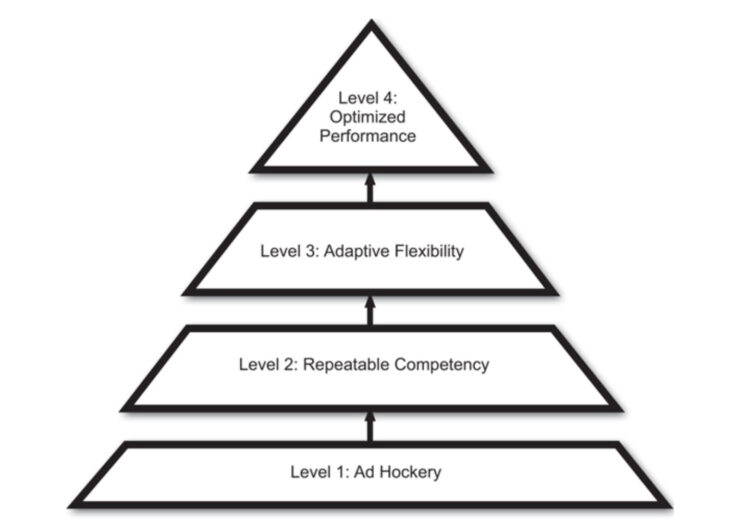
The Framework: The Negotiation Capability Model (NCM) defines four maturity levels from reactive approaches through repeatable processes to optimized partnership excellence.

The Solution: Sequential development through maturity levels, starting with repeatable competency to build foundations for adaptive flexibility and eventual partnership optimization.

The paradox of modern sports management reveals itself most clearly in negotiation practices. Organizations that meticulously systematize player development programs, implement sophisticated analytics platforms, and optimize performance through scientific methodology abandon all systematic thinking when approaching negotiations. Each contract discussion, facility deal, or sponsorship arrangement becomes an exercise in improvisation rather than institutional capability.

This inconsistency extends beyond operational inefficiency to strategic vulnerability. In an ecosystem where single negotiations determine competitive windows, financial trajectories, and organizational reputation, treating negotiation as artisanal craft rather than engineered competency represents fundamental strategic failure. The stakes—measured in hundreds of millions of dollars, decade-long commitments, and championship opportunities—demand systematic excellence rather than occasional brilliance.

This analysis presents the Negotiation Capability Model, a framework for understanding and developing organizational negotiation maturity. The discussion proceeds in three parts: first, diagnosing the current state of negotiation chaos plaguing sports organizations; second, examining the four maturity levels that define the progression toward excellence; and finally, outlining implementation strategies for systematic capability development.

Understanding the Challenge: The Ad Hockery Epidemic

Level 1 of the Negotiation Capability Model, termed “Ad Hockery,” describes the reactive, unstructured negotiation approaches that characterize most sports organizations. This state manifests not through lack of talent or effort but through absence of systematic frameworks that enable consistent excellence. Organizations operating in Ad Hockery treat each negotiation as unprecedented, relying on individual heroics rather than institutional capabilities to achieve outcomes.1

The symptoms of Ad Hockery permeate sports negotiations at every level. Contract discussions begin weeks before expiration rather than through strategic planning cycles. Success depends entirely on whoever leads the negotiation, with institutional knowledge evaporating when key personnel depart. Preparation consists of hasty comparable gathering rather than systematic stakeholder analysis. Measurement relies on subjective post-negotiation debriefs rather than objective performance metrics. These patterns repeat across player contracts, media rights, facility agreements, and sponsorship deals, creating unpredictable outcomes that undermine strategic planning.2

The tactical focus that characterizes Ad Hockery generates particular vulnerabilities in sports contexts. Negotiators concentrate on immediate deal terms—compensation, duration, specific clauses—without considering broader strategic implications. Teams might “win” contract negotiations while creating salary cap constraints that preclude future roster construction. Organizations might secure favorable facility terms while damaging political relationships essential for long-term success. Short-term victories achieved through Ad Hockery often produce long-term strategic defeats.

The persistence of Ad Hockery despite its obvious limitations reflects organizational blind spots about negotiation as a capability. Sports organizations that would never tolerate random approaches to player development or game preparation accept negotiation chaos as inevitable. This acceptance stems from misconceptions that negotiation success depends on innate talent rather than systematic development, that each situation is too unique for standardized approaches, or that formal processes constrain creativity. These beliefs perpetuate cycles of unpredictable outcomes, damaged relationships, and missed opportunities.

Case Illustration: The Free Agency Crisis Pattern

A professional basketball team operating in Ad Hockery approached their star player’s contract extension three weeks before free agency. Without systematic preparation or strategic alignment, negotiations devolved into positional bargaining over maximum salary demands. The rushed process damaged relationships, leaked to media creating public pressure, and ultimately resulted in the player’s departure—not over money, but due to process frustrations that systematic approaches would have prevented.

Framework Analysis: The Four Maturity Levels

Level 2, Repeatable Competency, represents the foundational transformation from chaos to consistency. Organizations at this level establish systematic approaches that produce predictable results across different negotiators and situations. Strategic alignment ensures every negotiation serves organizational objectives. Preparation follows standardized processes including market analysis, stakeholder mapping, and option development. Clear roles and authority eliminate confusion about decision-making. Measurement systems track both outcomes and process quality, enabling continuous improvement. These foundations create institutional memory that survives personnel changes while establishing baselines for further development.3

Level 3, Adaptive Flexibility, builds sophisticated capability for contextual optimization while maintaining systematic foundations. Organizations at this maturity level modify standard processes based on specific circumstances—long-term partners receive different approaches than new counterparts, strategic negotiations warrant deeper preparation than routine renewals. Negotiation strategies adapt to counterpart styles, constraints, and objectives rather than applying uniform approaches. Creative problem-solving transcends industry conventions when standard structures encounter obstacles. Rapid learning integration ensures lessons from each negotiation enhance organizational capability. This level represents mastery of both negotiation science and art.4

Level 4, Optimized Performance, transcends traditional negotiation paradigms through genuine partnership approaches. Organizations at this pinnacle collaborate with counterparts to design negotiation processes that maximize value creation rather than simply claiming existing value. Information sharing shifts from strategic withholding to transparent exchange that enables better decisions by all parties. Joint process design ensures negotiation approaches serve everyone’s interests. Focus moves from dividing current resources to expanding possibilities through creative collaboration. These approaches require exceptional trust and competence but generate outcomes impossible through traditional adversarial methods.

The progression through maturity levels follows necessary sequences that cannot be circumvented. Organizations cannot leap from Ad Hockery directly to Adaptive Flexibility because adaptation requires stable foundations that don’t exist at Level 1. Similarly, partnership approaches at Level 4 demand demonstrated competence and trustworthiness established through consistent performance at lower levels. Each level builds upon previous capabilities rather than replacing them—Level 4 organizations still employ systematic preparation and adaptive approaches, adding partnership elements when appropriate. This cumulative development creates compounding advantages as capabilities reinforce each other.5

Negotiation Capability Model Components

Level 1 – Ad Hockery: Reactive, unstructured approaches producing unpredictable results. Success depends on individual heroics, preparation is minimal, and learning is anecdotal.

Level 2 – Repeatable Competency: Systematic processes generating consistent outcomes. Strategic alignment, standardized preparation, clear roles, and measurement systems create institutional capability.

Level 3 – Adaptive Flexibility: Sophisticated contextual optimization. Standard processes modified for specific situations, counterpart analysis, creative problem-solving, and rapid learning integration.

Level 4 – Optimized Performance: Partnership-based value creation. Joint process design, transparent information sharing, collaborative problem-solving, and long-term relationship orientation.

“Negotiation maturity isn’t about being nice or avoiding difficult conversations. It’s about being strategically sophisticated enough to achieve your objectives consistently while building the relationships and reputation that create long-term organizational success.”

— Joshua A. Gordon, Strategic Negotiation: Building Organizational Excellence

Implementation Strategy: Building Maturity Systematically

Most sports organizations should initially focus on achieving Level 2 Repeatable Competency across critical negotiation functions. This pragmatic approach recognizes that foundational capabilities must exist before sophisticated adaptations become possible. The transition from Ad Hockery to Repeatable Competency generates immediate improvements in outcome predictability, relationship quality, and organizational learning while establishing platforms for future advancement. Organizations attempting to implement advanced techniques without basic foundations typically revert to Ad Hockery when pressure intensifies.6

Implementation begins with honest assessment of current negotiation practices across different organizational functions. Systematic evaluation tools identify where Ad Hockery dominates and which functions would benefit most from capability development. Player contract negotiations might operate at Level 2 while sponsorship discussions remain in Ad Hockery. Facility negotiations might show Level 3 sophistication while media rights discussions lack systematic approaches. This diagnostic mapping enables targeted development rather than generic training programs that fail to address specific organizational needs.

Priority functions—those most critical to organizational success or most frequently executed—receive initial development focus. For professional teams, this typically includes player contracts, coaching agreements, and key vendor relationships. For leagues, priority areas might encompass collective bargaining, media rights, and sponsor partnerships. Systematic development in these areas involves creating preparation templates, establishing decision authorities, implementing review processes, and building measurement systems. Initial implementations should be simple enough to ensure adoption while comprehensive enough to demonstrate value.

Continuous learning mechanisms transform individual negotiations into organizational capability development. Post-negotiation reviews examine not just outcomes but process execution, identifying what worked, what didn’t, and why. Lessons learned feed into updated procedures, refined templates, and enhanced training. Cross-functional sharing ensures insights from one negotiation domain inform others. This learning infrastructure differentiates organizations that continuously improve from those that repeat the same patterns regardless of results. Over time, accumulated learning creates competitive advantages that cannot be quickly replicated by competitors.7

Implementation Phases

Phase 1: Diagnostic Assessment

Systematically evaluate current negotiation practices across organizational functions using maturity model criteria. Identify gap areas, prioritize development needs, and establish baseline metrics for improvement tracking.

Phase 2: Foundation Building

Implement Level 2 capabilities in priority negotiation functions through standardized preparation processes, role clarification, authority definition, and basic measurement systems that create repeatable competency.

Phase 3: Capability Expansion

Develop Level 3 adaptive capabilities through counterpart analysis training, creative problem-solving workshops, and rapid learning integration systems while expanding Level 2 competencies to additional negotiation domains.

Practical Implications

For Athletic Administrators:
Recognize negotiation capability as strategic infrastructure requiring systematic development rather than hoping for individual brilliance. Allocate resources for process development, training, and continuous improvement. Establish clear expectations that negotiations follow systematic approaches rather than Ad Hockery. Create accountability systems that reward process excellence alongside outcome achievement, understanding that good processes generate better long-term results.

For Athletes and Representatives:
Evaluate organizational negotiation maturity when considering career decisions. Organizations operating at higher maturity levels typically create better outcomes for all parties through systematic preparation and creative problem-solving. Engage constructively in systematic negotiation processes rather than demanding Ad Hockery approaches. Recognize that structured negotiations often produce better outcomes than chaotic last-minute discussions.

For Legal Practitioners:
Support clients in developing systematic negotiation capabilities rather than simply executing individual deals. Help establish decision-making frameworks, authority structures, and review processes that enable consistent excellence. Document negotiation processes and outcomes to build institutional memory. Advocate for investment in negotiation capability development as essential infrastructure for long-term organizational success.

Conclusion

The journey from negotiation Ad Hockery to systematic excellence represents fundamental transformation in organizational capability. Sports organizations that develop negotiation maturity gain sustainable competitive advantages through predictable excellence, relationship capital, strategic flexibility, and continuous learning. These advantages compound over time, creating widening gaps between organizations that invest in systematic capability development and those that perpetuate chaotic approaches.

Implementation requires strategic patience and sustained commitment. Building negotiation maturity demands cultural change, process discipline, and investment in capabilities that may not generate immediate visible returns. Organizations must resist reverting to Ad Hockery when pressure intensifies or when individual negotiations become challenging. The temptation to abandon systematic approaches for heroic improvisation must be countered by leadership commitment to capability development.

The competitive dynamics of modern sports make negotiation excellence increasingly critical for organizational success. As player mobility increases, media landscapes fragment, and stakeholder expectations escalate, the ability to consistently execute complex negotiations becomes differentiating capability. Organizations that systematically develop from Ad Hockery through repeatable competency toward adaptive excellence position themselves for sustained success in increasingly complex negotiation environments.

Sources

1 Joshua A. Gordon & Gary Furlong, STRATEGIC NEGOTIATION: BUILDING ORGANIZATIONAL EXCELLENCE 45-78 (Routledge 2023).

2 Joshua A. Gordon, Gary Furlong & Ken Pendleton, THE SPORTS PLAYBOOK: BUILDING TEAMS THAT OUTPERFORM YEAR AFTER YEAR 156-189 (Routledge 2018).

3 Danny Ertel & Mark Gordon, THE POINT OF THE DEAL: HOW TO NEGOTIATE WHEN YES IS NOT ENOUGH 89-112 (Harvard Business Review Press 2007).

4 Hal Movius & Lawrence Susskind, BUILT TO WIN: CREATING A WORLD-CLASS NEGOTIATING ORGANIZATION 134-158 (Harvard Business Review Press 2009).

5 Roger Fisher, William Ury & Bruce Patton, GETTING TO YES: NEGOTIATING AGREEMENT WITHOUT GIVING IN 97-106 (3d ed. Penguin Books 2011).

6 David Lax & James Sebenius, 3-D NEGOTIATION: POWERFUL TOOLS TO CHANGE THE GAME IN YOUR MOST IMPORTANT DEALS 45-72 (Harvard Business Review Press 2006).

7 Michael Wheeler, THE ART OF NEGOTIATION: HOW TO IMPROVISE AGREEMENT IN A CHAOTIC WORLD 178-195 (Simon & Schuster 2013).

Note: All citations follow Bluebook format. For questions about specific citations, consult The Bluebook: A Uniform System of Citation (21st ed. 2020).

About the Author

Joshua A. Gordon serves as Woodard Family Foundation Fellow and Professor of Practice of Sports Business & Law as well as the Faculty Athletics Representative at the University of Oregon and Senior Practitioner at the Sports Conflict Institute. Read full bio →

Transform Your Negotiation Capability

Move from Ad Hockery to systematic excellence with expert guidance

Related Resources

Strategic Negotiation

Build organizational excellence through systematic negotiation capability

Learn More →

The Sports Playbook

Create winning teams through culture, character, and clarity

Discover the Framework →

The Missing Half: Why Individual Negotiation Skills Aren’t Enough in Sports

Sports organizations remain trapped in adversarial negotiation patterns that destroy value and damage relationships. Strategic negotiation offers a systematic framework for creating sustainable competitive advantages through interest-based problem solving, value creation, and organizational competence building that transforms how sports business operates.

Sports Conflict Institute
15-20 min read
Categories: Strategic Negotiation | Sports Business | Organizational Development

Executive Summary

The Problem: Traditional positional bargaining in sports creates adversarial relationships, suboptimal agreements, and destroys long-term value.

The Framework: Strategic negotiation principles transform zero-sum battles into collaborative problem-solving through systematic preparation and value creation.

The Solution: Building organizational negotiation competence creates sustainable competitive advantages through better deals, stronger relationships, and reduced conflict.

Negotiation permeates every aspect of sports business. Contract discussions between agents and front offices shape roster construction. Collective bargaining agreements determine league economics for decades. Sponsorship deals worth billions influence how fans experience their favorite sports. Yet despite negotiation’s omnipresence, most sports organizations approach these critical conversations with outdated methodologies that systematically destroy value.

The persistence of adversarial bargaining in sports represents a profound competitive disadvantage. Organizations clinging to win-lose paradigms leave millions on the table, damage essential relationships, and create unnecessary conflict that distracts from core objectives. Meanwhile, those embracing strategic negotiation principles gain sustainable advantages through superior agreements, stronger partnerships, and reduced friction.

This analysis examines the transformation from positional bargaining to strategic negotiation in sports business. The discussion proceeds in three parts: first, diagnosing the limitations of traditional adversarial approaches; second, exploring the strategic negotiation framework and its principles; and finally, implementing organizational competence building that creates lasting competitive advantages.

Understanding the Challenge: The Positional Bargaining Trap

Traditional sports negotiations follow predictable patterns that systematically undermine value creation. Each party stakes out extreme positions, viewing negotiation as a contest where gains by one side necessarily mean losses for the other. Contract negotiations become battles over fixed salary pools rather than explorations of creative structures benefiting all parties. Labor relations devolve into zero-sum warfare where winning matters more than growing the sport’s overall value. This positional approach dominates despite overwhelming evidence of its destructive effects.1

The costs of positional bargaining extend far beyond individual agreements. Adversarial negotiations poison future interactions, creating cycles of mistrust that make subsequent discussions increasingly difficult. Teams that approach player negotiations as battles often find themselves unable to retain talent or attract free agents, regardless of financial offers. Organizations known for aggressive positional tactics struggle to build productive partnerships with sponsors, media partners, and community stakeholders. The reputational damage from adversarial approaches compounds over time.2

Positional bargaining also generates systematically inferior agreements. When negotiators focus on claiming value rather than creating it, they miss opportunities for mutual gain that could benefit all parties. A player demanding maximum guaranteed money and a team insisting on performance incentives might both achieve their goals through creative structuring, but positional dynamics prevent such exploration. The resulting agreements satisfy no one fully, creating resentment that undermines implementation and future cooperation.

The opportunity costs of adversarial negotiation prove particularly damaging in sports contexts. Time spent on protracted positional battles diverts attention from competitive objectives. Resources consumed by labor disputes, contract holdouts, and facility negotiations could strengthen on-field performance. Energy devoted to internal conflicts reduces organizational capacity for innovation and adaptation. Organizations trapped in positional bargaining cycles find themselves perpetually distracted from their core mission of competitive excellence.

Case Illustration: The Hidden Costs of Positional Bargaining

A franchise enters contract negotiations viewing salary cap space as fixed, treating every dollar for the player as a loss for the team. After months of public posturing and damaged relationships, they reach a suboptimal deal that satisfies neither party. The player leaves in free agency, citing disrespect during negotiations, while the team’s reputation for difficult negotiations hampers future talent acquisition.

Labor relations in sports provide particularly stark examples of positional bargaining’s limitations. Leagues and player associations approaching collective bargaining as zero-sum battles often endure lengthy work stoppages that damage all stakeholders. Fans lose games, players lose salaries, owners lose revenue, and sports lose cultural relevance. The adversarial mindset that frames these negotiations as wars to be won rather than problems to be solved guarantees suboptimal outcomes regardless of which side claims victory.3

Facility negotiations between teams and municipalities demonstrate how positional approaches destroy community value. Teams threatening relocation unless demands are met and cities refusing any public investment both miss opportunities for creative partnerships. Stadium deals structured through positional bargaining often fail to serve any stakeholder well, creating public resentment, inadequate facilities, and missed economic development opportunities. The adversarial framing prevents exploration of innovative financing, revenue sharing, and community benefit structures that could align interests.

Framework Analysis: Strategic Negotiation Principles

Strategic negotiation represents a fundamental paradigm shift from adversarial bargaining to collaborative problem-solving. Rather than viewing negotiation as distributing fixed value, strategic negotiators focus on expanding possibilities before claiming shares. This approach doesn’t abandon competitive interests but pursues them through preparation, creativity, and relationship management rather than positional warfare. The framework rests on four interconnected principles that transform how organizations approach critical conversations.4

Interest-based problem solving forms the foundation of strategic negotiation. Instead of battling over positions, negotiators explore underlying interests driving those positions. A player demanding guaranteed money might be motivated by family security, market respect, or risk management. A team insisting on incentives might seek cost certainty, performance alignment, or salary cap flexibility. Understanding these interests opens creative solutions invisible to positional negotiators. Agreements can address multiple interests simultaneously through innovative structuring that creates value rather than simply dividing it.5

Value creation before value claiming distinguishes strategic negotiation from traditional approaches. Strategic negotiators invest significant energy expanding the pie before discussing distribution. This might involve identifying revenue streams that benefit all parties, structuring deals with variable components tied to mutual success, or incorporating non-monetary elements that cost little but provide substantial value. The sequence matters: premature focus on claiming value triggers adversarial dynamics that prevent creative exploration.

Relationship preservation recognizes that sports negotiations occur within ongoing relationships requiring future interaction. Today’s contract negotiation affects tomorrow’s team chemistry. Current labor discussions influence next decade’s collective bargaining. Strategic negotiators invest in maintaining relationships even during difficult conversations, understanding that trust and reputation represent long-term assets more valuable than any single agreement. This doesn’t mean avoiding tough discussions but conducting them in ways that strengthen rather than damage working relationships.

Strategic Negotiation Framework Components

Interest-Based Problem Solving: Explore motivations behind positions to identify creative solutions addressing multiple concerns simultaneously

Value Creation Focus: Expand possibilities through innovation before discussing distribution, identifying mutual gains invisible to positional bargainers

Systematic Preparation: Invest in research, option development, and scenario planning that enables flexibility and creativity during negotiations

Systematic preparation differentiates strategic negotiation from improvisational approaches. Elite athletes don’t improvise during competition—they prepare meticulously for every scenario. Similarly, strategic negotiators invest heavily in preparation, researching interests, developing options, analyzing alternatives, and anticipating challenges. This preparation enables flexibility during negotiations, as negotiators can adapt to new information while maintaining strategic direction. Organizations treating negotiation as systematic competence rather than individual art consistently achieve superior outcomes.6

The power of strategic negotiation becomes evident when examining successful sports partnerships. Revenue-sharing models that align league and player interests demonstrate value creation in action. Rather than fighting over fixed revenue, parties create mechanisms for mutual benefit through growth. Sponsorship deals incorporating performance bonuses, market development components, and brand activation opportunities illustrate how creative structuring serves multiple interests. These agreements succeed because negotiators focused on expanding possibilities rather than claiming predetermined shares.

“Organizations that master strategic negotiation gain competitive advantages that compound over time—better deals, stronger relationships, reduced conflict, and cultural alignment that enables sustained excellence.”

— Joshua A. Gordon & Gary Furlong, Strategic Negotiation

Implementation Strategy: Building Organizational Negotiation Competence

Transforming from positional bargaining to strategic negotiation requires systematic capability building across the organization. Too many sports organizations treat negotiation as an innate talent rather than a developable skill, relying on individual instincts rather than organizational systems. This approach guarantees inconsistent results and missed opportunities. Building negotiation competence demands investment in training, process development, and cultural transformation that embeds strategic principles throughout the organization.7

Personnel development forms the foundation of organizational negotiation competence. Contract negotiators, general managers, and executives need formal negotiation education grounded in strategic principles rather than learning through costly trial and error. Training programs should address interest identification, option generation, relationship management, and systematic preparation. Role-playing exercises using actual sports scenarios help participants internalize concepts and develop practical skills. Regular skill refreshment ensures capabilities remain sharp as personnel and contexts evolve.

Process systematization enables consistent application of strategic negotiation principles across different contexts and negotiators. Organizations need structured approaches to pre-negotiation preparation, including stakeholder analysis, interest mapping, and option development. Team coordination protocols ensure internal alignment during multi-party negotiations. Post-negotiation reviews capture lessons learned and identify improvement opportunities. These processes transform negotiation from individual performance to organizational capability, ensuring excellence survives personnel changes.

Cultural integration embeds strategic negotiation throughout organizational operations. Negotiation skills benefit not just front office executives but coaches working with players, marketing teams partnering with sponsors, and operations staff coordinating with vendors. Organizations fostering collaborative problem-solving internally develop muscles for external negotiations. Cultural norms valuing preparation, creativity, and relationship preservation create environments where strategic negotiation flourishes. This cultural transformation requires leadership commitment, consistent reinforcement, and alignment between espoused values and actual behaviors.

Implementation Phases

Phase 1: Assessment and Education

Evaluate current negotiation practices, identify capability gaps, and implement comprehensive training programs for key personnel across all organizational levels

Phase 2: Process Development

Create systematic approaches to preparation, team coordination, and post-negotiation learning that ensure consistent application of strategic principles

Phase 3: Cultural Transformation

Embed strategic negotiation principles throughout organizational culture through leadership modeling, reinforcement systems, and alignment with core values

Practical Implications

For Athletic Administrators:
Invest in formal negotiation training for all personnel involved in contracts, partnerships, and stakeholder relations. Develop systematic preparation processes that ensure consistency across negotiations. Create post-negotiation review protocols that capture lessons and improve future performance. Foster internal cultures valuing collaborative problem-solving over adversarial competition.

For Athletes and Representatives:
Approach contract negotiations as opportunities for value creation rather than zero-sum battles. Invest in understanding team interests beyond stated positions. Develop creative deal structures addressing multiple concerns simultaneously. Maintain relationships even during difficult negotiations, recognizing that reputation affects future opportunities across the industry.

For Legal Practitioners:
Structure agreements that align interests rather than simply documenting positions. Incorporate variable components linking outcomes to mutual success. Design dispute resolution mechanisms preventing escalation through early intervention. Build contractual frameworks enabling adaptation as circumstances change rather than requiring renegotiation.

Conclusion

The evolution from positional bargaining to strategic negotiation represents more than tactical refinement—it constitutes a fundamental transformation in how sports organizations create and capture value. Organizations clinging to adversarial approaches will find themselves increasingly disadvantaged as competitors embrace strategic principles that generate superior agreements, stronger relationships, and reduced conflict.

Building organizational negotiation competence requires sustained investment in training, process development, and cultural transformation. This investment pays compound returns through better deals, improved partnerships, and reduced friction that enables focus on competitive excellence. The capabilities developed through strategic negotiation extend beyond individual agreements to create systemic advantages in talent acquisition, partnership development, and stakeholder management.

The future of sports business belongs to organizations that recognize negotiation as core competence deserving systematic development. Those that master strategic negotiation will discover that moving beyond win-lose thinking doesn’t mean abandoning competitive interests—it means pursuing them more effectively through preparation, creativity, and collaboration that unlocks value invisible to positional bargainers.

Sources

1 Joshua A. Gordon & Gary Furlong, STRATEGIC NEGOTIATION: BUILDING ORGANIZATIONAL EXCELLENCE 23-45 (Routledge 2023).

2 Joshua A. Gordon, Gary Furlong & Ken Pendleton, THE SPORTS PLAYBOOK: BUILDING TEAMS THAT OUTPERFORM YEAR AFTER YEAR 167-189 (Routledge 2018).

3 Roger Fisher, William Ury & Bruce Patton, GETTING TO YES: NEGOTIATING AGREEMENT WITHOUT GIVING IN 3-14 (Penguin Books 3d ed. 2011).

4 William Ury, GETTING PAST NO: NEGOTIATING IN DIFFICULT SITUATIONS 18-36 (Bantam Books rev. ed. 2007).

5 Chris Voss & Tahl Raz, NEVER SPLIT THE DIFFERENCE: NEGOTIATING AS IF YOUR LIFE DEPENDED ON IT 89-112 (HarperBusiness 2016).

6 Deepak Malhotra & Max Bazerman, NEGOTIATION GENIUS: HOW TO OVERCOME OBSTACLES AND ACHIEVE BRILLIANT RESULTS AT THE BARGAINING TABLE AND BEYOND 45-71 (Bantam Books 2008).

7 G. Richard Shell, BARGAINING FOR ADVANTAGE: NEGOTIATION STRATEGIES FOR REASONABLE PEOPLE 157-182 (Penguin Books 3d ed. 2018).

Note: All citations follow Bluebook format. For questions about specific citations, consult The Bluebook: A Uniform System of Citation (21st ed. 2020).

About the Author

Joshua A. Gordon is a Professor of Practice of Sports Business & Law and serves as Faculty Athletics Representative at the University of Oregon and Senior Practitioner of the Sports Conflict Institute. Read full bio →

Transform Your Organization’s Negotiation Capability

Build systematic competence that creates lasting competitive advantages through strategic negotiation

Related Resources

Strategic Negotiation

Build organizational excellence through systematic negotiation capability

Learn More →

The Sports Playbook

Create winning teams through culture, character, and clarity

Discover the Framework →

The Revenue Game: Transforming Sports Business Development from Transactions to Partnerships

Modern sports revenue generation extends beyond traditional sales into complex multi-party negotiations spanning naming rights, media partnerships, and global licensing. Strategic revenue negotiation transforms transactional deal-making into partnership orchestration, creating sustainable competitive advantages through systematic value architecture, partner-centric analysis, and portfolio integration.

Sports Conflict Institute
15-20 min read
Categories: Revenue Strategy | Partnership Development | Sports Business

Executive Summary

The Problem: Sports organizations approach revenue negotiations with outdated transactional mindsets, focusing on immediate deal value rather than strategic partnerships that create long-term competitive advantages.

The Framework: Comprehensive value architecture combining partner-centric needs analysis, creative structuring, portfolio integration, and data-driven demonstration.

The Solution: Building organizational revenue excellence through systematic processes, team development, and strategic planning integration that transforms deal-making into partnership orchestration.

The transformation of sports business from entertainment product to global platform has fundamentally altered revenue generation dynamics. Contemporary sports organizations navigate ecosystems where naming rights deals exceed hundreds of millions, media partnerships reshape entire leagues, and digital integrations blur traditional boundaries between content and commerce. This evolution demands negotiation sophistication that transcends traditional sales methodologies.

Yet organizational practices lag behind market complexity. Revenue teams approach billion-dollar negotiations with frameworks designed for simpler transactions, pursuing immediate value maximization rather than strategic partnership development. This misalignment between market sophistication and negotiation capability creates systematic underperformance, leaving significant value unrealized while competitors build sustainable advantages through partnership excellence.

This analysis examines the evolution from transactional revenue generation to strategic partnership orchestration. The discussion proceeds in three parts: first, identifying the limitations of traditional approaches in modern sports markets; second, presenting frameworks for strategic revenue negotiation; and finally, outlining organizational capabilities required for sustainable revenue excellence.

Understanding the Challenge: The Transactional Trap

Traditional sports revenue approaches evolved when partnerships were simpler and more predictable. Organizations sold discrete assets—stadium naming rights, jersey sponsorships, broadcast windows—through straightforward transactions with clear deliverables and fixed terms. Success meant maximizing price for defined inventory, with negotiations focused on rate cards, comparables, and advertising equivalencies. This transactional paradigm served adequately when revenue streams were limited, partners sought simple brand exposure, and fan engagement occurred primarily through physical venues.1

Modern sports ecosystems render transactional approaches obsolete. Partners seek strategic business outcomes rather than advertising impressions. Digital transformation creates infinite inventory possibilities that defy traditional pricing models. Global audiences demand authentic engagement rather than passive consumption. Multi-platform distribution fragments traditional media models while creating new partnership categories. These dynamics require negotiation approaches that embrace complexity rather than reducing partnerships to commodity transactions. Organizations persisting with transactional mindsets systematically undervalue their assets while missing opportunities for transformative partnerships.2

The persistence of transactional thinking manifests in predictable patterns across sports organizations. Revenue teams operate in silos, pursuing individual deals without considering portfolio implications. Negotiations focus on immediate financial terms rather than long-term relationship potential. Partnership agreements remain static despite rapidly evolving market conditions. Performance measurement emphasizes revenue totals rather than strategic value creation. These patterns reinforce themselves through organizational structures, compensation systems, and cultural norms that reward short-term revenue maximization over sustainable partnership development.

The opportunity cost of transactional approaches compounds over time. Organizations miss chances to create integrated partnerships that multiply value across multiple touchpoints. They fail to build deep relationships that generate organic growth and expansion opportunities. They leave strategic advantages unexploited while competitors develop partnership ecosystems that create sustainable differentiation. Most critically, they train partners to view sports relationships as advertising purchases rather than strategic investments, perpetuating commodity dynamics that suppress valuations across the entire industry.

Case Illustration: The Regional Bank Partnership Evolution

A regional bank initially approached a baseball team seeking traditional outfield signage. Strategic needs analysis revealed their real challenge: competing with national banks for younger customers who viewed traditional banking as outdated. The evolved partnership included digital education content, mobile banking demonstrations during games, and community investment showcases—transforming the bank from advertiser to authentic community partner while generating triple the initially proposed investment.

Framework Analysis: Strategic Revenue Architecture

Comprehensive value architecture transforms revenue negotiation from price optimization to value creation across multiple dimensions. Strategic negotiators map five distinct value categories that sports properties offer: brand association value through emotional connections with passionate fan communities; data and intelligence value providing consumer insights that inform business strategies; platform and distribution value accessing audiences through unique channels; innovation and content value enabling authentic storytelling; and community relationship value building genuine loyalty beyond transactional interactions. This multi-dimensional framework reveals partnership opportunities invisible through traditional advertising lenses.3

Partner-centric needs analysis shifts focus from what organizations want to sell to what partners need to achieve. This requires understanding business objectives beyond marketing goals—growth strategies, competitive challenges, customer acquisition costs, and innovation imperatives. Strategic revenue negotiators explore how sports partnerships address fundamental business problems rather than simply providing brand exposure. They identify customer journey touchpoints where sports integration creates unique value. They uncover differentiation opportunities that help partners stand out in commoditized markets. This deep understanding enables creative partnership structures that align interests while maximizing mutual value creation.4

Portfolio integration and cross-selling multiply partnership value through strategic orchestration. Elite revenue generators understand that individual partnerships should reinforce rather than compete with each other. This requires developing complementary partnership portfolios where different partners’ objectives create synergistic opportunities. Cross-promotion structures allow partners to collaborate, creating additional value streams while strengthening relationships with the sports property. Integrated activation planning ensures coherent fan experiences rather than competing messages. Technology partnerships might enhance automotive showcases while financial services partners provide transaction platforms, creating ecosystems where each partnership strengthens others.

Data-driven value demonstration replaces anecdotal success stories with systematic performance measurement. Modern partnerships require sophisticated analytics that prove value across multiple dimensions—brand metrics, business outcomes, fan engagement, and relationship quality. Predictive modeling forecasts partnership performance, enabling optimized deal structures. Real-time optimization creates feedback loops for continuous improvement. Competitive intelligence informs valuation strategies and negotiation approaches. This analytical foundation transforms negotiations from debates about theoretical value to discussions grounded in demonstrable performance, building partner confidence while justifying premium investments.5

Strategic Revenue Framework Components

Value Architecture: Multi-dimensional mapping of brand association, data intelligence, platform distribution, innovation content, and community relationship value that reveals opportunities beyond traditional advertising metrics.

Partner Analysis: Deep understanding of business objectives, customer journeys, and differentiation needs that enables creative structures addressing fundamental business challenges rather than marketing tactics.

Portfolio Integration: Strategic orchestration of complementary partnerships creating multiplicative value through cross-promotion, integrated activation, and ecosystem development.

Performance Demonstration: Sophisticated analytics infrastructure providing predictive modeling, real-time optimization, and competitive intelligence that transforms theoretical discussions into data-driven negotiations.

“The future of sports business belongs to organizations that understand revenue generation as strategic partnership development rather than transactional selling. Those that master this transition will build sustainable competitive advantages that compound over time.”

— Joshua A. Gordon, Strategic Negotiation: Building Organizational Excellence

Implementation Strategy: Building Revenue Excellence

Organizational revenue excellence requires systematic capabilities that transcend individual negotiation skills. Revenue team development begins with cross-functional integration, ensuring revenue generators collaborate with marketing, operations, fan experience, and competitive teams to create coherent partnership strategies. Specialized expertise development builds deep knowledge of specific industries, partnership types, and market segments. Continuous learning programs keep teams current with industry trends, negotiation techniques, and partnership management best practices. This human capital investment creates sustainable advantages that compound through accumulated experience and institutional knowledge.6

Systematic processes and tools enable consistent excellence across all partnership relationships. Partnership pipeline management creates structured approaches to identifying, qualifying, and developing opportunities. Sophisticated proposal and presentation systems communicate value while customizing approaches for different partners. Performance tracking and analysis infrastructure supports both partnership optimization and future negotiation strategies. These systems transform revenue generation from individual heroics to institutional capability, ensuring consistent excellence regardless of personnel changes. Technology platforms integrate customer relationship management, financial modeling, and performance analytics into unified workflows that accelerate partnership development while improving decision quality.

Advanced negotiation strategies address increasingly complex partnership structures in global sports markets. Multi-party partnership orchestration manages negotiations involving multiple brands, properties, or stakeholders, creating value for all participants through coalition building and sophisticated value distribution mechanisms. Global and cultural adaptation ensures partnership structures comply with varying international regulations while maximizing local market relevance. Technology-enabled revenue innovation incorporates digital assets, streaming rights, and virtual experiences into partnership structures. These advanced capabilities position organizations at the forefront of revenue innovation, creating first-mover advantages in emerging partnership categories.

Strategic planning integration ensures revenue development supports broader organizational objectives rather than operating as an independent function. Revenue strategies align with competitive positioning, brand development, and fan experience priorities. Market positioning uses partnership choices to reinforce desired organizational identity and differentiation. Risk management builds portfolio approaches balancing concentration with diversification across industries and deal structures. This strategic coherence ensures revenue partnerships strengthen rather than compromise organizational strategy, creating reinforcing cycles where partnership success enables further strategic development.7

Implementation Phases

Phase 1: Revenue Capability Assessment

Evaluate current revenue practices against strategic framework components, identifying gaps in value architecture understanding, partner analysis capabilities, portfolio integration, and performance measurement systems that limit partnership potential.

Phase 2: System and Process Development

Build systematic approaches for partnership pipeline management, proposal development, performance tracking, and relationship management that transform individual excellence into organizational capability.

Phase 3: Strategic Partnership Evolution

Transition existing transactional relationships toward strategic partnerships through systematic renegotiation, expanded value creation, and deepened integration while developing new partnerships using advanced frameworks.

Practical Implications

For Athletic Administrators:
Recognize revenue generation as strategic capability requiring systematic investment rather than relying on individual sales talent. Restructure revenue organizations to support partnership development rather than transaction processing. Create compensation and recognition systems that reward long-term relationship building alongside immediate revenue generation. Invest in analytics infrastructure that demonstrates partnership value beyond traditional advertising metrics.

For Corporate Partners:
Approach sports partnerships as strategic business opportunities rather than marketing expenses. Engage early in partnership development to shape structures that address fundamental business objectives. Invest in activation and measurement capabilities that maximize partnership value realization. Evaluate sports properties based on strategic alignment and partnership sophistication rather than simply audience demographics.

For Legal Practitioners:
Develop expertise in complex partnership structures that balance flexibility with protection. Create adaptive agreement frameworks that accommodate evolving digital platforms and fan engagement models. Structure performance-based components that align partner and property interests. Build portfolio management approaches that optimize across multiple partnership relationships while managing exclusivity conflicts.

Conclusion

The evolution from transactional revenue generation to strategic partnership orchestration represents fundamental transformation in sports business capability. Organizations that develop sophisticated revenue negotiation competencies gain sustainable advantages through premium partnership attraction, revenue stability and growth, market differentiation, and enhanced fan experiences. These advantages compound over time as partnership success creates reputation benefits that attract increasingly sophisticated partners seeking genuine strategic value.

Implementation requires sustained commitment to capability development rather than quick fixes or isolated training programs. Organizations must invest in people, processes, and technologies that enable systematic excellence across all partnership relationships. Leadership must champion long-term relationship building over short-term revenue maximization, creating cultural change that permeates entire organizations. This transformation challenges established practices and power structures, requiring courage to pursue strategic excellence despite institutional inertia.

The competitive landscape of modern sports business makes revenue excellence increasingly critical for organizational sustainability. As traditional revenue sources face pressure from changing consumption patterns and technological disruption, partnership innovation becomes essential for financial stability and growth. Organizations that master strategic revenue negotiation will thrive in this environment, building partnership ecosystems that create value impossible through traditional transactional approaches. The question facing sports organizations is not whether to transform revenue practices but how quickly they can build capabilities before competitors establish insurmountable advantages.

Sources

1 Joshua A. Gordon & Gary Furlong, STRATEGIC NEGOTIATION: BUILDING ORGANIZATIONAL EXCELLENCE 234-267 (Routledge 2023).

2 Joshua A. Gordon, Gary Furlong & Ken Pendleton, THE SPORTS PLAYBOOK: BUILDING TEAMS THAT OUTPERFORM YEAR AFTER YEAR 198-221 (Routledge 2018).

3 Stefan Szymanski & Andrew Zimbalist, NATIONAL PASTIME: HOW AMERICANS PLAY BASEBALL AND THE REST OF THE WORLD PLAYS SOCCER 145-172 (Brookings Institution Press 2005).

4 Dennis Howard & John Crompton, FINANCING SPORT 289-315 (3d ed. Fitness Information Technology 2014).

5 T. Bettina Cornwell, SPONSORSHIP IN MARKETING: EFFECTIVE PARTNERSHIPS IN SPORTS, ARTS AND EVENTS 78-102 (2d ed. Routledge 2020).

6 Bill Sutton & Mark McDonald, SPORT MARKETING 412-438 (5th ed. Human Kinetics 2021).

7 George Foster, Norm O’Reilly & Antonio Dávila, SPORTS BUSINESS MANAGEMENT: DECISION MAKING AROUND THE GLOBE 234-256 (2d ed. Routledge 2020).

Note: All citations follow Bluebook format. For questions about specific citations, consult The Bluebook: A Uniform System of Citation (21st ed. 2020).

About the Author

Joshua A. Gordon serves as Woodard Family Foundation Fellow and Professor of Practice of Sports Business & Law as well as the Faculty Athletics Representative at the University of Oregon and Senior Practitioner at the Sports Conflict Institute. Read full bio →

Transform Your Revenue Strategy

Build strategic partnerships that create sustainable competitive advantages

Related Resources

Strategic Negotiation

Build organizational excellence through systematic negotiation capability

Learn More →

The Sports Playbook

Create winning teams through culture, character, and clarity

Discover the Framework →

Beyond Win-Lose: Why Strategic Negotiation is the Future of Sports Business

Sports organizations remain trapped in adversarial negotiation patterns that destroy value and damage relationships. Strategic negotiation offers a systematic framework for creating sustainable competitive advantages through interest-based problem solving, value creation, and organizational competence building that transforms how sports business operates.

Sports Conflict Institute
15-20 min read
Categories: Strategic Negotiation | Sports Business | Organizational Development

Executive Summary

The Problem: Traditional positional bargaining in sports creates adversarial relationships, suboptimal agreements, and destroys long-term value.

The Framework: Strategic negotiation principles transform zero-sum battles into collaborative problem-solving through systematic preparation and value creation.

The Solution: Building organizational negotiation competence creates sustainable competitive advantages through better deals, stronger relationships, and reduced conflict.

Negotiation permeates every aspect of sports business. Contract discussions between agents and front offices shape roster construction. Collective bargaining agreements determine league economics for decades. Sponsorship deals worth billions influence how fans experience their favorite sports. Yet despite negotiation’s omnipresence, most sports organizations approach these critical conversations with outdated methodologies that systematically destroy value.

The persistence of adversarial bargaining in sports represents a profound competitive disadvantage. Organizations clinging to win-lose paradigms leave millions on the table, damage essential relationships, and create unnecessary conflict that distracts from core objectives. Meanwhile, those embracing strategic negotiation principles gain sustainable advantages through superior agreements, stronger partnerships, and reduced friction.

This analysis examines the transformation from positional bargaining to strategic negotiation in sports business. The discussion proceeds in three parts: first, diagnosing the limitations of traditional adversarial approaches; second, exploring the strategic negotiation framework and its principles; and finally, implementing organizational competence building that creates lasting competitive advantages.

Understanding the Challenge: The Positional Bargaining Trap

Traditional sports negotiations follow predictable patterns that systematically undermine value creation. Each party stakes out extreme positions, viewing negotiation as a contest where gains by one side necessarily mean losses for the other. Contract negotiations become battles over fixed salary pools rather than explorations of creative structures benefiting all parties. Labor relations devolve into zero-sum warfare where winning matters more than growing the sport’s overall value. This positional approach dominates despite overwhelming evidence of its destructive effects.1

The costs of positional bargaining extend far beyond individual agreements. Adversarial negotiations poison future interactions, creating cycles of mistrust that make subsequent discussions increasingly difficult. Teams that approach player negotiations as battles often find themselves unable to retain talent or attract free agents, regardless of financial offers. Organizations known for aggressive positional tactics struggle to build productive partnerships with sponsors, media partners, and community stakeholders. The reputational damage from adversarial approaches compounds over time.2

Positional bargaining also generates systematically inferior agreements. When negotiators focus on claiming value rather than creating it, they miss opportunities for mutual gain that could benefit all parties. A player demanding maximum guaranteed money and a team insisting on performance incentives might both achieve their goals through creative structuring, but positional dynamics prevent such exploration. The resulting agreements satisfy no one fully, creating resentment that undermines implementation and future cooperation.

The opportunity costs of adversarial negotiation prove particularly damaging in sports contexts. Time spent on protracted positional battles diverts attention from competitive objectives. Resources consumed by labor disputes, contract holdouts, and facility negotiations could strengthen on-field performance. Energy devoted to internal conflicts reduces organizational capacity for innovation and adaptation. Organizations trapped in positional bargaining cycles find themselves perpetually distracted from their core mission of competitive excellence.

Case Illustration: The Hidden Costs of Positional Bargaining

A franchise enters contract negotiations viewing salary cap space as fixed, treating every dollar for the player as a loss for the team. After months of public posturing and damaged relationships, they reach a suboptimal deal that satisfies neither party. The player leaves in free agency, citing disrespect during negotiations, while the team’s reputation for difficult negotiations hampers future talent acquisition.

Labor relations in sports provide particularly stark examples of positional bargaining’s limitations. Leagues and player associations approaching collective bargaining as zero-sum battles often endure lengthy work stoppages that damage all stakeholders. Fans lose games, players lose salaries, owners lose revenue, and sports lose cultural relevance. The adversarial mindset that frames these negotiations as wars to be won rather than problems to be solved guarantees suboptimal outcomes regardless of which side claims victory.3

Facility negotiations between teams and municipalities demonstrate how positional approaches destroy community value. Teams threatening relocation unless demands are met and cities refusing any public investment both miss opportunities for creative partnerships. Stadium deals structured through positional bargaining often fail to serve any stakeholder well, creating public resentment, inadequate facilities, and missed economic development opportunities. The adversarial framing prevents exploration of innovative financing, revenue sharing, and community benefit structures that could align interests.

Framework Analysis: Strategic Negotiation Principles

Strategic negotiation represents a fundamental paradigm shift from adversarial bargaining to collaborative problem-solving. Rather than viewing negotiation as distributing fixed value, strategic negotiators focus on expanding possibilities before claiming shares. This approach doesn’t abandon competitive interests but pursues them through preparation, creativity, and relationship management rather than positional warfare. The framework rests on four interconnected principles that transform how organizations approach critical conversations.4

Interest-based problem solving forms the foundation of strategic negotiation. Instead of battling over positions, negotiators explore underlying interests driving those positions. A player demanding guaranteed money might be motivated by family security, market respect, or risk management. A team insisting on incentives might seek cost certainty, performance alignment, or salary cap flexibility. Understanding these interests opens creative solutions invisible to positional negotiators. Agreements can address multiple interests simultaneously through innovative structuring that creates value rather than simply dividing it.5

Value creation before value claiming distinguishes strategic negotiation from traditional approaches. Strategic negotiators invest significant energy expanding the pie before discussing distribution. This might involve identifying revenue streams that benefit all parties, structuring deals with variable components tied to mutual success, or incorporating non-monetary elements that cost little but provide substantial value. The sequence matters: premature focus on claiming value triggers adversarial dynamics that prevent creative exploration.

Relationship preservation recognizes that sports negotiations occur within ongoing relationships requiring future interaction. Today’s contract negotiation affects tomorrow’s team chemistry. Current labor discussions influence next decade’s collective bargaining. Strategic negotiators invest in maintaining relationships even during difficult conversations, understanding that trust and reputation represent long-term assets more valuable than any single agreement. This doesn’t mean avoiding tough discussions but conducting them in ways that strengthen rather than damage working relationships.

Strategic Negotiation Framework Components

Interest-Based Problem Solving: Explore motivations behind positions to identify creative solutions addressing multiple concerns simultaneously

Value Creation Focus: Expand possibilities through innovation before discussing distribution, identifying mutual gains invisible to positional bargainers

Systematic Preparation: Invest in research, option development, and scenario planning that enables flexibility and creativity during negotiations

Systematic preparation differentiates strategic negotiation from improvisational approaches. Elite athletes don’t improvise during competition—they prepare meticulously for every scenario. Similarly, strategic negotiators invest heavily in preparation, researching interests, developing options, analyzing alternatives, and anticipating challenges. This preparation enables flexibility during negotiations, as negotiators can adapt to new information while maintaining strategic direction. Organizations treating negotiation as systematic competence rather than individual art consistently achieve superior outcomes.6

The power of strategic negotiation becomes evident when examining successful sports partnerships. Revenue-sharing models that align league and player interests demonstrate value creation in action. Rather than fighting over fixed revenue, parties create mechanisms for mutual benefit through growth. Sponsorship deals incorporating performance bonuses, market development components, and brand activation opportunities illustrate how creative structuring serves multiple interests. These agreements succeed because negotiators focused on expanding possibilities rather than claiming predetermined shares.

“Organizations that master strategic negotiation gain competitive advantages that compound over time—better deals, stronger relationships, reduced conflict, and cultural alignment that enables sustained excellence.”

— Joshua A. Gordon & Gary Furlong, Strategic Negotiation

Implementation Strategy: Building Organizational Negotiation Competence

Transforming from positional bargaining to strategic negotiation requires systematic capability building across the organization. Too many sports organizations treat negotiation as an innate talent rather than a developable skill, relying on individual instincts rather than organizational systems. This approach guarantees inconsistent results and missed opportunities. Building negotiation competence demands investment in training, process development, and cultural transformation that embeds strategic principles throughout the organization.7

Personnel development forms the foundation of organizational negotiation competence. Contract negotiators, general managers, and executives need formal negotiation education grounded in strategic principles rather than learning through costly trial and error. Training programs should address interest identification, option generation, relationship management, and systematic preparation. Role-playing exercises using actual sports scenarios help participants internalize concepts and develop practical skills. Regular skill refreshment ensures capabilities remain sharp as personnel and contexts evolve.

Process systematization enables consistent application of strategic negotiation principles across different contexts and negotiators. Organizations need structured approaches to pre-negotiation preparation, including stakeholder analysis, interest mapping, and option development. Team coordination protocols ensure internal alignment during multi-party negotiations. Post-negotiation reviews capture lessons learned and identify improvement opportunities. These processes transform negotiation from individual performance to organizational capability, ensuring excellence survives personnel changes.

Cultural integration embeds strategic negotiation throughout organizational operations. Negotiation skills benefit not just front office executives but coaches working with players, marketing teams partnering with sponsors, and operations staff coordinating with vendors. Organizations fostering collaborative problem-solving internally develop muscles for external negotiations. Cultural norms valuing preparation, creativity, and relationship preservation create environments where strategic negotiation flourishes. This cultural transformation requires leadership commitment, consistent reinforcement, and alignment between espoused values and actual behaviors.

Implementation Phases

Phase 1: Assessment and Education

Evaluate current negotiation practices, identify capability gaps, and implement comprehensive training programs for key personnel across all organizational levels

Phase 2: Process Development

Create systematic approaches to preparation, team coordination, and post-negotiation learning that ensure consistent application of strategic principles

Phase 3: Cultural Transformation

Embed strategic negotiation principles throughout organizational culture through leadership modeling, reinforcement systems, and alignment with core values

Practical Implications

For Athletic Administrators:
Invest in formal negotiation training for all personnel involved in contracts, partnerships, and stakeholder relations. Develop systematic preparation processes that ensure consistency across negotiations. Create post-negotiation review protocols that capture lessons and improve future performance. Foster internal cultures valuing collaborative problem-solving over adversarial competition.

For Athletes and Representatives:
Approach contract negotiations as opportunities for value creation rather than zero-sum battles. Invest in understanding team interests beyond stated positions. Develop creative deal structures addressing multiple concerns simultaneously. Maintain relationships even during difficult negotiations, recognizing that reputation affects future opportunities across the industry.

For Legal Practitioners:
Structure agreements that align interests rather than simply documenting positions. Incorporate variable components linking outcomes to mutual success. Design dispute resolution mechanisms preventing escalation through early intervention. Build contractual frameworks enabling adaptation as circumstances change rather than requiring renegotiation.

Conclusion

The evolution from positional bargaining to strategic negotiation represents more than tactical refinement—it constitutes a fundamental transformation in how sports organizations create and capture value. Organizations clinging to adversarial approaches will find themselves increasingly disadvantaged as competitors embrace strategic principles that generate superior agreements, stronger relationships, and reduced conflict.

Building organizational negotiation competence requires sustained investment in training, process development, and cultural transformation. This investment pays compound returns through better deals, improved partnerships, and reduced friction that enables focus on competitive excellence. The capabilities developed through strategic negotiation extend beyond individual agreements to create systemic advantages in talent acquisition, partnership development, and stakeholder management.

The future of sports business belongs to organizations that recognize negotiation as core competence deserving systematic development. Those that master strategic negotiation will discover that moving beyond win-lose thinking doesn’t mean abandoning competitive interests—it means pursuing them more effectively through preparation, creativity, and collaboration that unlocks value invisible to positional bargainers.

Sources

1 Joshua A. Gordon & Gary Furlong, STRATEGIC NEGOTIATION: BUILDING ORGANIZATIONAL EXCELLENCE 23-45 (Routledge 2023).

2 Joshua A. Gordon, Gary Furlong & Ken Pendleton, THE SPORTS PLAYBOOK: BUILDING TEAMS THAT OUTPERFORM YEAR AFTER YEAR 167-189 (Routledge 2018).

3 Roger Fisher, William Ury & Bruce Patton, GETTING TO YES: NEGOTIATING AGREEMENT WITHOUT GIVING IN 3-14 (Penguin Books 3d ed. 2011).

4 William Ury, GETTING PAST NO: NEGOTIATING IN DIFFICULT SITUATIONS 18-36 (Bantam Books rev. ed. 2007).

5 Chris Voss & Tahl Raz, NEVER SPLIT THE DIFFERENCE: NEGOTIATING AS IF YOUR LIFE DEPENDED ON IT 89-112 (HarperBusiness 2016).

6 Deepak Malhotra & Max Bazerman, NEGOTIATION GENIUS: HOW TO OVERCOME OBSTACLES AND ACHIEVE BRILLIANT RESULTS AT THE BARGAINING TABLE AND BEYOND 45-71 (Bantam Books 2008).

7 G. Richard Shell, BARGAINING FOR ADVANTAGE: NEGOTIATION STRATEGIES FOR REASONABLE PEOPLE 157-182 (Penguin Books 3d ed. 2018).

Note: All citations follow Bluebook format. For questions about specific citations, consult The Bluebook: A Uniform System of Citation (21st ed. 2020).

About the Author

Joshua A. Gordon is a Professor of Practice of Sports Business & Law and serves as Faculty Athletics Representative at the University of Oregon and Senior Practitioner of the Sports Conflict Institute. Read full bio →

Transform Your Organization’s Negotiation Capability

Build systematic competence that creates lasting competitive advantages through strategic negotiation

Related Resources

Strategic Negotiation

Build organizational excellence through systematic negotiation capability

Learn More →

The Sports Playbook

Create winning teams through culture, character, and clarity

Discover the Framework →

Building Negotiation Excellence in Sports: Strategic Systems for Sports Governance and Commercial Success

Sports organizations approach negotiation as individual skill rather than organizational capability, missing strategic opportunities in governance and commercial contexts. The Negotiation Capability Model provides systematic frameworks for building institutional excellence, transforming reactive deal-making into strategic asset development that creates sustainable competitive advantages across all negotiation domains.

Sports Conflict Institute
15-20 min read
Categories: Strategic Negotiation | Sports Governance | Organizational Development

Executive Summary

The Problem: Sports organizations treat negotiation as transactional skill rather than strategic capability, leading to reactive approaches that undermine long-term success in both commercial and governance contexts.

The Framework: The Negotiation Capability Model (NCM) provides systematic progression from ad hoc approaches through repeatable competency to optimized collaborative performance.

The Solution: Building organizational negotiation excellence through six critical capabilities that align individual skills with institutional systems and strategic objectives.

Negotiation permeates every aspect of sports organizations, from billion-dollar media rights agreements to governance reforms that reshape entire leagues. Player contracts determine competitive windows, sponsorship deals define financial sustainability, and collective bargaining agreements establish operational frameworks for decades. Yet despite negotiation’s central role in determining organizational success, sports entities persist in treating it as individual artistry rather than institutional capability.

This disconnect between negotiation’s strategic importance and its operational treatment creates systematic underperformance across the sports industry. Organizations celebrate occasional negotiation victories while ignoring patterns of missed opportunities, damaged relationships, and strategic misalignment. The reliance on individual negotiation talent rather than organizational systems leaves institutions vulnerable to personnel changes, market disruptions, and competitive disadvantages that compound over time.

This analysis examines how sports organizations can transform negotiation from reactive skill to strategic asset. The discussion proceeds in three parts: first, diagnosing the hidden costs of ad hoc negotiation approaches; second, presenting the Negotiation Capability Model as a framework for systematic development; and finally, outlining implementation strategies for building organizational excellence in both commercial and governance contexts.

Understanding the Challenge: The Hidden Costs of Ad Hoc Negotiation

The sports industry’s approach to negotiation reflects historical evolution rather than strategic design. Organizations developed negotiation practices organically, responding to immediate needs rather than building systematic capabilities. General managers negotiate player contracts based on personal experience and market intuition. League executives manage governance disputes through crisis response rather than proactive frameworks. Commercial teams pursue sponsorship deals using sales techniques rather than strategic partnership methodologies. This evolutionary approach creates predictable vulnerabilities that manifest across both commercial and governance domains.1

Commercial negotiations suffer particularly from ad hoc approaches that prioritize immediate revenue over strategic value creation. Sponsorship negotiations focus on maximizing fees rather than building partnerships that enhance both parties’ strategic objectives. Media rights discussions emphasize distribution breadth rather than audience engagement quality. Player contract negotiations create salary structures that optimize individual deals while undermining team-building flexibility. These transactional approaches generate short-term wins that often compromise long-term competitive positioning. Organizations celebrate securing high-value sponsorships without considering brand alignment implications or operational integration challenges.2

Governance negotiations reveal equally problematic patterns when approached without systematic frameworks. League expansion discussions devolve into positional bargaining between existing owners and prospective franchises. Collective bargaining becomes adversarial combat rather than collaborative problem-solving. Regulatory compliance negotiations with governing bodies focus on minimizing penalties rather than addressing underlying systemic issues. International competition structures emerge from power dynamics rather than strategic optimization. These governance failures create cascading consequences—labor disputes that cancel seasons, expansion decisions that dilute competitive quality, and regulatory frameworks that stifle innovation.

The opportunity costs of ad hoc negotiation extend beyond individual deal outcomes to organizational culture and capability development. When negotiation success depends on individual heroics, organizations fail to build institutional knowledge that survives personnel changes. When each negotiation starts from scratch, organizations cannot leverage accumulated experience for continuous improvement. When negotiation approaches vary by individual preference, organizations cannot ensure consistent alignment with strategic objectives. These cultural and capability gaps create competitive disadvantages that widen over time as more sophisticated organizations develop systematic negotiation excellence.

Case Illustration: The Premier League Media Rights Revolution

The English Premier League transformed from middle-tier European league to global powerhouse through systematic negotiation excellence. Rather than individual clubs negotiating separately, they created collective frameworks that maximized total value while ensuring competitive balance. Their media rights negotiations evolved from selling broadcast windows to creating strategic partnerships with global distributors, generating revenues that transformed not just the league but English football’s entire ecosystem.

Framework Analysis: The Negotiation Capability Model in Sports

The Negotiation Capability Model (NCM) provides systematic frameworks for advancing organizational negotiation maturity through four distinct levels. Level 1, Ad Hockery, characterizes organizations where negotiations occur reactively without consistent processes or strategic alignment—the current state for most sports entities. Level 2, Repeatable Competency, establishes standardized practices that produce predictable outcomes, essential for organizations managing regular negotiations like player contracts or annual sponsorships. Level 3, Adaptive Flexibility, enables tailored approaches for specific contexts while maintaining systematic foundations, ideal for leagues managing diverse stakeholder interests. Level 4, Optimized Performance, achieves collaborative negotiations that create new value categories, exemplified by innovative partnership structures in professional sports.3

Six critical capabilities enable progression through NCM maturity levels, each requiring specific development in sports contexts. Strategy, Values, and Direction (SVD) ensures negotiations align with organizational objectives, whether maximizing competitive success or ensuring governance integrity. Individual Fit (IF) develops negotiators who operate within organizational frameworks while leveraging personal strengths. Human Capital and Organizational Investment (HCOI) builds systematic training programs and knowledge management systems that capture negotiation learning. Knowledge and Skills (KS) develops advanced capabilities tailored to sports-specific contexts like salary cap management or international federation politics. Organizational Incentives (OI) aligns reward systems with long-term strategic objectives rather than short-term deal closure. Individual Interests (II) balances personal motivations with institutional priorities to ensure sustained commitment.4

Commercial applications of NCM transform transactional deal-making into strategic partnership development. Sponsorship negotiations evolve from selling inventory to creating integrated partnerships that advance both parties’ business objectives. Media rights discussions shift from maximizing fees to optimizing audience engagement and platform innovation. Venue negotiations expand beyond lease terms to encompass fan experience enhancement and community integration. Player contract frameworks balance individual compensation with team-building flexibility and salary cap optimization. These commercial applications demonstrate how systematic negotiation approaches generate superior financial outcomes while strengthening strategic positioning.

Governance applications address complex multi-stakeholder negotiations that determine sports’ structural foundations. Collective bargaining frameworks evolve from adversarial confrontation to collaborative problem-solving that addresses both player welfare and league sustainability. International competition structures emerge from systematic stakeholder engagement rather than political maneuvering. Regulatory compliance negotiations focus on systemic improvement rather than penalty minimization. League expansion processes balance growth opportunities with competitive integrity through transparent, criterion-based evaluation. These governance applications illustrate how negotiation excellence creates sustainable frameworks that serve all stakeholders while advancing sport development.5

Six Critical Negotiation Capabilities for Sports Organizations

Strategy, Values & Direction: Aligning every negotiation with organizational mission, whether pursuing championships, financial sustainability, or governance reform.

Individual Fit: Selecting and developing negotiators whose capabilities and values align with organizational culture and strategic objectives.

Human Capital Investment: Building systematic training programs, knowledge management systems, and career development paths for negotiation excellence.

Knowledge & Skills: Developing sports-specific negotiation expertise in areas like salary cap management, media rights valuation, and stakeholder engagement.

Organizational Incentives: Structuring rewards that encourage long-term value creation rather than short-term deal closure.

Individual Interests: Balancing personal career objectives with institutional priorities to ensure sustained excellence.

“Negotiation is not merely a tool for resolving disputes or closing deals but a strategic asset that can drive alignment, create value, and establish a competitive advantage—if managed systemically.”

— Gary Furlong & Joshua A. Gordon, Strategic Negotiation: Building Organizational Excellence

Implementation Strategy: Building Organizational Excellence

Implementation begins with comprehensive assessment using tools like the Negotiation Assessment Tool (NAT) to diagnose current organizational maturity across the six critical capabilities. This diagnostic process reveals specific gaps between current practices and desired capabilities, enabling targeted development rather than generic training programs. Assessment should examine both commercial and governance negotiation domains, recognizing that organizations often exhibit different maturity levels across functional areas. Player contract negotiations might demonstrate repeatable competency while sponsorship discussions remain in ad hockery. International competition negotiations might show adaptive flexibility while domestic governance discussions lack systematic approaches.6

Capability development requires systematic investment in people, processes, and technology that enable negotiation excellence. Training programs must address both individual skills and organizational systems, ensuring negotiators understand not just tactical techniques but strategic frameworks. Knowledge management systems capture lessons from each negotiation, building institutional memory that improves future performance. Technology platforms integrate negotiation planning, execution, and analysis into unified workflows. Process standardization ensures consistent approaches while maintaining flexibility for context-specific adaptation. These investments transform negotiation from individual art to organizational science, creating sustainable capabilities that survive personnel changes.

Cultural transformation accompanies structural development, requiring leadership commitment to negotiation as strategic priority. Organizations must shift from celebrating individual negotiation victories to recognizing systematic excellence. Performance metrics evolve from focusing solely on deal terms to encompassing relationship quality, strategic alignment, and long-term value creation. Career development paths recognize negotiation expertise as core competency rather than ancillary skill. Cross-functional collaboration ensures negotiation strategies align with competitive, financial, and operational objectives. This cultural shift positions negotiation excellence as organizational differentiator rather than operational necessity.

Continuous improvement mechanisms ensure negotiation capabilities evolve with changing market conditions and stakeholder expectations. Regular capability assessments track progress toward maturity objectives while identifying emerging development needs. Benchmarking against industry leaders reveals best practices and innovation opportunities. Stakeholder feedback illuminates relationship impacts and value creation effectiveness. Market analysis identifies shifting dynamics that require capability adaptation. These continuous improvement processes ensure organizations maintain negotiation excellence rather than allowing capabilities to atrophy through complacency.7

Implementation Phases

Phase 1: Diagnostic Assessment

Comprehensive evaluation of current negotiation practices across commercial and governance domains using the Negotiation Assessment Tool, identifying capability gaps and development priorities aligned with strategic objectives.

Phase 2: Capability Development

Systematic building of negotiation infrastructure including training programs, knowledge management systems, process standardization, and technology platforms that transform individual skills into organizational capabilities.

Phase 3: Cultural Integration

Embedding negotiation excellence into organizational culture through leadership commitment, performance metrics evolution, career development paths, and cross-functional collaboration that positions negotiation as strategic differentiator.

Practical Implications

For League Executives and Administrators:
Recognize negotiation capability as critical infrastructure requiring systematic development rather than relying on individual expertise. Invest in comprehensive assessment to identify capability gaps across commercial and governance domains. Build training programs that address both tactical skills and strategic frameworks. Create knowledge management systems that capture institutional learning from every negotiation. Establish performance metrics that balance immediate outcomes with long-term relationship and strategic considerations.

For Team Owners and Operators:
Develop negotiation capabilities that span player contracts, sponsorship agreements, and stakeholder relationships. Ensure front office structures support systematic negotiation excellence rather than individual heroics. Create alignment between negotiation approaches and competitive strategies. Build capabilities for managing complex multi-party negotiations in areas like facility development and media partnerships. Invest in technology platforms that enable data-driven negotiation planning and execution.

For Governance Bodies and Federations:
Transform governance negotiations from adversarial confrontations to collaborative problem-solving through systematic frameworks. Develop capabilities for managing multi-stakeholder negotiations that balance diverse interests. Create transparent processes that build trust while advancing strategic objectives. Invest in training programs that equip governance representatives with both negotiation skills and stakeholder engagement capabilities. Establish continuous improvement mechanisms that adapt to evolving governance challenges.

Conclusion

The transformation from ad hoc negotiation to organizational excellence represents fundamental evolution in sports management capability. Organizations that develop systematic negotiation competencies gain sustainable advantages in both commercial performance and governance effectiveness. These advantages manifest through superior deal outcomes, stronger stakeholder relationships, enhanced strategic alignment, and improved organizational resilience. The compounding nature of negotiation excellence creates widening gaps between organizations that invest in systematic capabilities and those that persist with reactive approaches.

Implementation requires sustained commitment from leadership, systematic investment in capability development, and cultural transformation that positions negotiation as strategic priority. Organizations must resist the temptation to rely on individual negotiation talents or quick-fix training programs. Building organizational negotiation excellence demands patience, resources, and strategic vision that extends beyond immediate deal pressures. The organizations that make these investments position themselves for long-term success in increasingly complex sports ecosystems.

The competitive dynamics of modern sports make negotiation excellence increasingly critical for organizational sustainability. As commercial partnerships grow more sophisticated, governance challenges become more complex, and stakeholder expectations escalate, the ability to negotiate effectively across multiple domains becomes essential differentiator. Organizations that master systematic negotiation capabilities will shape the future of sports, while those that maintain ad hoc approaches will struggle to compete. The choice facing sports organizations is clear: develop negotiation excellence as strategic capability or accept competitive disadvantage in both commercial and governance arenas.

Sources

1 Joshua A. Gordon & Gary Furlong, STRATEGIC NEGOTIATION: BUILDING ORGANIZATIONAL EXCELLENCE 12-34 (Routledge 2023).

2 Joshua A. Gordon, Gary Furlong & Ken Pendleton, THE SPORTS PLAYBOOK: BUILDING TEAMS THAT OUTPERFORM YEAR AFTER YEAR 67-92 (Routledge 2018).

3 Danny Ertel, Turning Negotiation into a Corporate Capability, 77 HARV. BUS. REV. 55-70 (May-June 1999).

4 Hal Movius & Lawrence Susskind, BUILT TO WIN: CREATING A WORLD-CLASS NEGOTIATING ORGANIZATION 89-115 (Harvard Business Review Press 2009).

5 Stephen Weatherford, Sports Law: A Managerial Approach, 23 J. LEGAL ASPECTS SPORT 147-162 (2013).

6 Roger Fisher & Danny Ertel, GETTING READY TO NEGOTIATE: THE GETTING TO YES WORKBOOK 23-45 (Penguin Books 1995).

7 Michael Wheeler, THE ART OF NEGOTIATION: HOW TO IMPROVISE AGREEMENT IN A CHAOTIC WORLD 201-223 (Simon & Schuster 2013).

Note: All citations follow Bluebook format. For questions about specific citations, consult The Bluebook: A Uniform System of Citation (21st ed. 2020).

About the Author

Joshua A. Gordon serves as Woodard Family Foundation Fellow and Professor of Practice of Sports Business & Law as well as the Faculty Athletics Representative at the University of Oregon and Senior Practitioner at the Sports Conflict Institute. Read full bio →

Transform Your Organization’s Negotiation Capability

Move from reactive tactics to strategic excellence with proven frameworks

Related Resources

Strategic Negotiation

Build organizational excellence through systematic negotiation capability

Learn More →

The Sports Playbook

Create winning teams through culture, character, and clarity

Discover the Framework →
PlayPlay

The Price of Conflict in Sports: How Mismanaged Conflict Undermines Success

Destructive conflict in sports generates direct costs exceeding millions, reputation damage lasting years, and performance degradation that compounds over seasons. Analysis reveals reactive approaches cost 100 times more than proactive systems. This framework quantifies conflict’s triple impact—financial, reputational, and competitive—while demonstrating how preventive conflict management transforms liability into strategic advantage.

Sports Conflict Institute
15-20 min read
Categories: Conflict Economics | Risk Management | Organizational Performance

Executive Summary

The Problem: Sports organizations systematically underestimate conflict’s true costs, treating destructive incidents as isolated events rather than predictable organizational liabilities requiring strategic management.

The Framework: A comprehensive cost model measuring conflict’s triple impact through direct financial costs, reputation/brand degradation, and performance deterioration across stakeholder groups.

The Solution: Proactive conflict management systems that cost 1% of reactive approaches while generating positive returns in reputation enhancement and performance optimization.

When university athletic directors receive calls about coaching misconduct, they enter predictable crisis cycles that destroy value across multiple dimensions. The pattern repeats with disturbing frequency: initial incident, media exposure, administrative scrambling, public relations damage control, personnel changes, legal proceedings, and eventual settlement. Each stage compounds costs that could have been prevented through systematic conflict management, yet organizations persist in reactive approaches that guarantee maximum damage.

The persistence of reactive conflict management despite overwhelming evidence of its inefficiency reflects fundamental misconceptions about conflict’s nature in sports organizations. Leaders treat destructive incidents as unpredictable anomalies rather than systemic risks requiring proactive management. They calculate visible costs while ignoring hidden impacts on culture, recruitment, and competitive positioning. They invest millions in performance optimization while accepting conflict-related performance degradation as inevitable.

This analysis quantifies conflict’s comprehensive costs across financial, reputational, and competitive dimensions. The discussion proceeds in three parts: first, establishing the triple-impact framework for understanding conflict costs; second, presenting empirical evidence comparing reactive versus proactive approaches; and finally, outlining implementation strategies for transforming conflict from liability to strategic advantage.

Understanding the Challenge: The Triple Impact of Destructive Conflict

Direct financial costs represent conflict’s most visible but least comprehensive impact. These tangible expenses include staff time devoted to crisis management, contract buyouts, legal fees, settlements, regulatory fines, and public relations interventions. A single coaching misconduct incident typically generates immediate costs exceeding four million dollars through contract termination alone, with additional expenses for investigations, replacements, and damage control. These unbudgeted expenditures strain resources, disrupt operations, and divert investment from strategic initiatives. Organizations forced into reactive crisis management sacrifice long-term development for short-term survival.1

Reputation and brand costs create lasting damage that compounds over years. One destructive incident can negate ten positive stories, fundamentally altering public perception of entire institutions. The reputational impact manifests through lost ticket sales, merchandise revenue erosion, sponsorship withdrawal, donor disengagement, and compromised recruiting ability. Major programs have seen attendance decline by twenty percent following scandals, with recovery requiring sustained multi-year efforts. Digital amplification ensures incidents achieve global visibility within hours, making reputation management increasingly complex. Social media transforms isolated events into viral narratives that define institutional identity for prospective students, athletes, and partners.2

Performance costs directly undermine competitive success through multiple mechanisms. Internal conflict disrupts team cohesion, compromises focus, and degrades execution quality. Athletes operating in toxic environments underperform relative to their potential, with studies showing fifteen to twenty percent performance degradation in conflict-affected teams. Coaching instability destroys continuity in system implementation and player development. Recruiting suffers as top prospects avoid programs with cultural dysfunction. The compound effect transforms championship contenders into rebuilding projects, with recovery cycles typically spanning three to five years.

The interaction between cost categories creates multiplicative rather than additive effects. Financial strain limits resources for reputation repair and performance enhancement. Reputation damage reduces revenue streams needed for competitive investment. Performance decline diminishes brand value and financial returns. This negative spiral transforms manageable challenges into existential threats, explaining why conflict-affected programs often require complete organizational overhauls rather than incremental improvements. Understanding these interconnections reveals why prevention generates exponentially higher returns than crisis response.

Case Illustration: The $4.5 Million Coaching Crisis

A Division I basketball program’s hazing incident generated $4,162,500 in direct costs (coach buyout, legal fees, PR crisis management), $300,000 in immediate revenue losses from attendance decline, and unmeasured performance impacts including tournament absence and three-year rebuilding. The same institution could have invested $50,000 in proactive conflict systems, preventing the incident while enhancing culture—a 100:1 cost differential that defines the economics of sports conflict.

Framework Analysis: Quantifying Stakeholder Impact

Comprehensive cost analysis requires examining impacts across all stakeholder groups, each experiencing distinct but interconnected consequences. Administrators face revenue stream losses, brand damage requiring years to repair, liability exposure threatening career survival, and operational disruption preventing strategic advancement. The average athletic director dealing with major conflict spends forty percent of their time on crisis management rather than program development. Coaches experience team performance degradation, financial penalties through suspension or termination, career trajectory disruption, and reputational damage affecting future opportunities. Studies indicate coaches involved in public conflicts see average career earnings reduced by thirty to fifty percent.3

Athletes bear particularly severe consequences from organizational conflict, often without proportional control over prevention. Performance optimization suffers when energy diverts to managing dysfunctional environments rather than skill development. Scholarship losses and eligibility impacts threaten educational opportunities. Professional prospects diminish through association with troubled programs. Personal development stalls in toxic cultures that prioritize damage control over growth. The lifetime earnings impact for athletes in conflict-affected programs averages $2.3 million through reduced professional opportunities and endorsement potential. These individual costs aggregate into institutional liabilities through legal action, requiring systematic risk management.4

External stakeholders—donors, sponsors, fans, and community members—experience costs that ultimately flow back to organizations through reduced support. Donors defer or withdraw contributions when institutions demonstrate poor governance, with major gifts declining by an average of thirty-five percent following scandals. Corporate sponsors face brand contamination risks, leading to contract renegotiations or terminations worth millions in lost revenue. Season ticket holders and merchandise purchasers reduce spending, creating immediate revenue impacts while signaling long-term disengagement. Community support erodes as institutions violate public trust, compromising political capital needed for facility development and operational support.

Temporal analysis reveals how costs compound over time when conflicts remain unaddressed. Initial incidents generating thousands in management costs escalate to millions in crisis response when allowed to fester. Early intervention points exist where minimal investment prevents catastrophic outcomes, similar to preventive maintenance in physical infrastructure. The technology sector’s bug detection models demonstrate that problems caught in development cost one hundred times less than those reaching production. Sports organizations can apply similar early detection and intervention systems, transforming conflict management from reactive scrambling to strategic optimization.5

Comparative Cost Analysis: Reactive vs. Proactive Approaches

Reactive Response: $4,162,500 direct costs + significant reputation damage + performance decline. Crisis management consumes resources, disrupts operations, and guarantees negative outcomes across all impact categories.

Proactive Investment: $50,000 prevention systems + reputation enhancement + performance optimization. Early detection and systematic intervention prevent incidents while building cultural strength and competitive advantage.

Return on Prevention: 100:1 cost advantage + positive brand differentiation + sustained competitive success. Every dollar invested in conflict prevention saves one hundred dollars in crisis response while generating additional value through cultural excellence.

“Conflict resolution training, assessment and evaluation can be the early detection system in an athletic department that identifies potential personnel problems before they become big and costly. Prevention is not just the right thing to do—it’s the strategic imperative for sustainable success.”

— Sports Conflict Institute, Cost of Sports Conflict White Paper

Implementation Strategy: Building Proactive Conflict Management Systems

Proactive conflict management begins with systematic assessment that identifies risk factors before they manifest as crises. Comprehensive evaluation examines cultural dynamics, communication patterns, power structures, and behavioral indicators that predict destructive conflict. Anonymous surveys capture authentic stakeholder perspectives often hidden from leadership. Focus groups reveal underlying tensions and emerging issues. Behavioral analysis identifies high-risk individuals and situations requiring targeted intervention. This diagnostic foundation enables precision prevention rather than broad-brush policies that fail to address specific vulnerabilities. Organizations implementing systematic assessment reduce conflict incidents by seventy percent while improving overall culture metrics.6

Early intervention systems transform identified risks into development opportunities through targeted skill building and structural adjustment. Conflict resolution training equips stakeholders with tools for constructive engagement, transforming potential disputes into collaborative problem-solving. Communication protocols establish clear channels for addressing concerns before they escalate. Mediation services provide neutral facilitation for emerging conflicts, preventing adversarial dynamics. Cultural alignment processes ensure individual and organizational values synchronize, reducing friction from mismatched expectations. These interventions cost fractions of crisis response while generating positive returns through enhanced collaboration and innovation.

Structural prevention addresses systemic factors that generate conflict rather than treating symptoms. Clear behavioral expectations eliminate ambiguity that enables misconduct. Transparent accountability systems ensure consistent consequences for violations. Power balance mechanisms prevent exploitation of hierarchical advantages. Diversity and inclusion initiatives reduce identity-based conflicts. Compensation and incentive alignment minimizes zero-sum competition. These structural elements create environments where destructive conflict cannot take root, similar to fire-resistant building design that prevents ignition rather than relying on suppression.

Continuous improvement ensures conflict management systems evolve with changing contexts and emerging challenges. Regular climate assessments track cultural health indicators and identify developing issues. Incident analysis examines near-misses and minor conflicts for systemic learning. Benchmarking against industry leaders reveals innovation opportunities. Stakeholder feedback loops ensure systems remain responsive to actual needs. Return on investment measurement demonstrates value creation and justifies continued investment. This iterative refinement transforms conflict management from static compliance to dynamic capability that generates sustained competitive advantage.7

Implementation Phases

Phase 1: Risk Assessment and Baseline Establishment

Comprehensive evaluation of current conflict patterns, cultural dynamics, and systemic vulnerabilities using validated assessment tools. Establish baseline metrics for conflict frequency, intensity, and impact to enable progress measurement.

Phase 2: System Design and Capability Building

Develop early warning systems, intervention protocols, and resolution mechanisms tailored to identified risks. Build stakeholder capabilities through training, tool development, and practice opportunities that transform conflict into growth catalyst.

Phase 3: Integration and Optimization

Embed conflict management into organizational operations through policy integration, performance metrics, and cultural reinforcement. Continuously refine systems based on outcomes data and stakeholder feedback to maximize return on investment.

Practical Implications

For Athletic Administrators:
Recognize conflict management as critical risk infrastructure requiring systematic investment equivalent to physical safety systems. Allocate budgets for proactive assessment and prevention that generate 100:1 returns compared to crisis response. Establish clear metrics linking conflict management to financial performance, reputation measures, and competitive success. Create accountability structures that reward prevention rather than heroic crisis management.

For Coaches and Staff:
Develop conflict resolution skills as core professional competencies equivalent to technical expertise. Recognize early warning signs of destructive dynamics and intervene before escalation. Model constructive conflict engagement that transforms disagreement into innovation opportunity. Build team cultures where psychological safety enables performance optimization through honest communication and collaborative problem-solving.

For Legal and Risk Management:
Shift from reactive litigation management to proactive risk prevention through systematic conflict assessment and intervention. Develop documentation systems that capture near-misses and minor incidents for pattern analysis. Create early intervention protocols that address issues before legal thresholds. Calculate total conflict costs including hidden impacts to justify prevention investments that reduce liability exposure.

Conclusion

The economics of sports conflict present a clear imperative: organizations can invest thousands in prevention or millions in crisis response. The 100:1 cost differential between proactive and reactive approaches represents one of the highest return opportunities in sports management, yet most organizations continue accepting preventable losses. This persistence of inefficient practices despite overwhelming evidence reflects not ignorance but institutional inertia that treats conflict as inevitable rather than manageable.

Transformation requires reconceptualizing conflict from unpredictable crisis to systematic risk requiring professional management. Just as organizations invest in strength and conditioning to prevent physical injuries, they must invest in cultural and relational systems to prevent destructive conflicts. The tools, techniques, and evidence exist; implementation depends on leadership courage to challenge traditional reactive paradigms. Organizations that make this shift gain competitive advantages through reduced costs, enhanced reputation, and optimized performance.

The choice facing sports organizations crystallizes into fundamental strategic decision: continue absorbing millions in preventable conflict costs or invest thousands in systems that transform potential crises into growth opportunities. As competition intensifies and margins narrow, organizations cannot afford the luxury of reactive conflict management. Those that build proactive capabilities will thrive through cultural excellence, while those maintaining traditional approaches will struggle under mounting costs of preventable conflicts. The question is not whether to invest in conflict management, but how quickly organizations can build these capabilities before the next crisis strikes.

Sources

1 Sports Conflict Institute, THE COST OF SPORTS CONFLICT WHITE PAPER 3-5 (Sports Conflict Institute 2015).

2 Joshua A. Gordon, Gary Furlong & Ken Pendleton, THE SPORTS PLAYBOOK: BUILDING TEAMS THAT OUTPERFORM YEAR AFTER YEAR 23-47 (Routledge 2018).

3 Kenneth Cloke & Joan Goldsmith, RESOLVING CONFLICTS AT WORK: TEN STRATEGIES FOR EVERYONE ON THE JOB 156-178 (3d ed. Jossey-Bass 2011).

4 Dana Dana & Roger Fisher, Measuring the Costs and Benefits of Conflict Resolution, 1 NEGOT. J. 389-404 (2005).

5 CPP Global, WORKPLACE CONFLICT AND HOW BUSINESSES CAN HARNESS IT TO THRIVE 12-18 (CPP Global Human Capital Report, July 2008).

6 Daniel Dana, THE DANA MEASURE OF FINANCIAL COST OF ORGANIZATIONAL CONFLICT (MTI Publications 2001).

7 Joshua A. Gordon & Gary Furlong, STRATEGIC NEGOTIATION: BUILDING ORGANIZATIONAL EXCELLENCE 178-203 (Routledge 2023).

Note: All citations follow Bluebook format. For questions about specific citations, consult The Bluebook: A Uniform System of Citation (21st ed. 2020).

About the Author

Joshua A. Gordon serves as Woodard Family Foundation Fellow and Professor of Practice of Sports Business & Law as well as the Faculty Athletics Representative at the University of Oregon and Senior Practitioner at the Sports Conflict Institute. Read full bio →

Prevent the Next Million-Dollar Crisis

Transform conflict from costly liability to competitive advantage

Related Resources

Strategic Negotiation

Build organizational excellence through systematic negotiation capability

Learn More →

The Sports Playbook

Create winning teams through culture, character, and clarity

Discover the Framework →
PlayPlay

Investigation vs. Assessment in Intercollegiate Athletics: Understanding the Distinctions

Intercollegiate athletics departments frequently conflate investigations and assessments, applying fault-finding processes to culture problems or developmental approaches to compliance violations. This framework distinguishes between retrospective investigations for policy violations and forward-looking assessments for organizational development, enabling strategic selection of appropriate interventions that maximize institutional effectiveness while minimizing legal exposure.

Sports Conflict Institute
15-20 min read
Categories: Athletic Governance | Compliance | Organizational Development

Executive Summary

The Problem: Athletic departments misapply investigative and assessment tools, using backward-looking fault-finding for forward-looking culture problems and collaborative assessments for compliance violations requiring accountability.

The Framework: Clear delineation between investigations (retrospective, policy-focused, fault-attributing) and assessments (forward-looking, solution-oriented, development-focused) based on situation requirements and institutional objectives.

The Solution: Strategic selection protocols that match intervention methodology to situational requirements, ensuring legal compliance while maximizing organizational development opportunities.

The complexity of modern intercollegiate athletics creates situations requiring fundamentally different intervention approaches, yet institutional leaders consistently apply mismatched methodologies that exacerbate problems rather than resolve them. When Title IX violations demand accountability determination, collaborative assessments fail to establish necessary fault attribution. When toxic cultures require systemic transformation, investigative approaches generate defensive responses that prevent authentic change. This methodological confusion represents more than procedural error—it reflects fundamental misunderstanding of how different tools serve distinct institutional purposes.

The consequences of misapplied interventions cascade through athletic departments, creating secondary problems that often exceed original challenges. Investigations applied to culture problems generate adversarial dynamics that entrench dysfunction. Assessments used for compliance violations expose institutions to legal liability through inadequate documentation and accountability. These errors stem not from incompetence but from insufficient frameworks distinguishing when each approach serves institutional interests most effectively.

This analysis establishes clear distinctions between investigations and assessments in intercollegiate athletics contexts. The discussion proceeds in three parts: first, examining the endemic confusion that leads to misapplied interventions; second, delineating the fundamental characteristics and appropriate applications of each approach; and finally, presenting strategic selection frameworks that ensure methodological alignment with situational requirements and institutional objectives.

Understanding the Challenge: The Cost of Methodological Confusion

Athletic departments operate under simultaneous pressures that demand both accountability enforcement and cultural development, creating situations where leaders must rapidly determine appropriate intervention strategies. The default response often reflects institutional bias rather than situational analysis—compliance-oriented departments launch investigations for every concern while development-focused institutions attempt collaborative assessment even for serious violations. Neither approach serves effectively when misapplied, generating cascading failures that compromise both legal standing and organizational health. The frequency of these misapplications suggests systemic confusion rather than isolated judgment errors.1

Legal exposure intensifies when assessment methodologies address situations requiring formal investigation. Title IX violations, hazing incidents, and financial improprieties demand documented processes establishing fact patterns, determining policy violations, and attributing responsibility. Assessment approaches that prioritize collaboration and future improvement fail to create defensible records for regulatory review or litigation defense. Institutions attempting cultural assessment for sexual assault allegations face devastating legal consequences when informal processes compromise evidence preservation and witness testimony. The Office for Civil Rights consistently sanctions institutions whose collaborative approaches to Title IX violations fail to meet investigative standards, generating millions in legal costs and reputational damage.2

Cultural damage occurs equally when investigative approaches address systemic dysfunction requiring collaborative transformation. Teams experiencing communication breakdowns, leadership conflicts, or performance degradation need forward-looking interventions that build trust and establish shared vision. Investigations that seek fault attribution for cultural problems generate defensive responses, destroy psychological safety, and entrench existing divisions. Coaches subjected to investigations for “poor culture” become adversarial rather than collaborative, athletes fear retaliation for honest participation, and administrators focus on liability protection rather than genuine improvement. The investigative framework transforms potential learning opportunities into survival contests where stakeholders protect individual interests rather than pursuing collective excellence.

Resource inefficiency compounds when mismatched methodologies require subsequent corrective interventions. Investigations that fail to address underlying cultural issues necessitate repeated inquiries as problems resurface in different forms. Assessments that inadequately document compliance violations require formal investigations when regulatory scrutiny intensifies. This duplication wastes financial resources, exhausts stakeholder patience, and delays necessary improvements. Athletic departments report spending forty percent more on sequential interventions compared to appropriate initial approaches. The opportunity costs extend beyond direct expenses to include lost recruiting advantages, donor disengagement, and competitive disadvantage during protracted resolution processes.

Case Illustration: The Basketball Program Paradox

A Division I basketball program facing cultural dysfunction initiated formal investigation seeking accountability for “toxic environment.” The adversarial process destroyed remaining trust, leading to mass transfers and coaching staff turnover. Subsequent assessment revealed systemic communication failures requiring collaborative intervention, but damage from investigation made authentic engagement impossible. The program required complete reconstruction over three years—outcomes preventable through appropriate initial assessment focused on cultural transformation rather than fault attribution.

Framework Analysis: Distinguishing Investigations from Assessments

Investigations operate through forensic methodologies designed to establish factual accuracy regarding past events, determine policy violations, and attribute individual responsibility. The retrospective focus examines what happened, when it occurred, who participated, and whether actions violated established standards. Evidence collection follows legal protocols ensuring admissibility in formal proceedings. Witness interviews employ structured questioning designed to elicit specific information while preserving testimony integrity. Documentation standards meet regulatory requirements for completeness, accuracy, and chain of custody. The investigative process intentionally maintains independence from operational stakeholders to ensure objectivity and credibility. Conclusions definitively state whether violations occurred and identify responsible parties for appropriate sanctions.3

Assessments utilize diagnostic methodologies examining current organizational states to identify improvement opportunities and develop implementation strategies. The forward-looking orientation explores existing dynamics, systemic patterns, and cultural factors that enable or constrain performance. Data collection employs multiple methods including surveys, focus groups, observations, and document review to construct comprehensive organizational pictures. Stakeholder engagement prioritizes psychological safety and authentic participation over formal testimony. Analysis identifies root causes rather than individual fault, recognizing that systemic issues typically transcend personal responsibility. Recommendations emphasize practical interventions, capability building, and structural adjustments that enable sustainable improvement. The assessment process requires collaborative partnership with organizational members who must ultimately implement recommended changes.4

Temporal orientation fundamentally distinguishes investigations from assessments beyond surface methodological differences. Investigations reconstruct historical events with precision required for accountability determination, examining decision points, action sequences, and causal relationships that produced specific outcomes. This backward focus necessitates forensic rigor that can withstand adversarial challenge in legal or regulatory proceedings. Assessments project forward from current baselines toward desired future states, identifying gaps between present reality and organizational aspirations. This prospective orientation enables creative solution development unconstrained by historical precedent. The temporal distinction determines everything from data collection methods to stakeholder engagement strategies to output formats.

Attribution requirements create divergent frameworks for investigations versus assessments. Investigations must establish individual culpability with sufficient certainty to justify employment actions, regulatory sanctions, or legal consequences. This fault-finding imperative drives adversarial dynamics as subjects protect themselves through legal representation, selective disclosure, and defensive positioning. Assessments explicitly avoid individual blame to enable honest examination of systemic factors contributing to organizational challenges. This no-fault approach encourages authentic participation, innovative thinking, and collective ownership of improvement initiatives. The attribution distinction shapes every aspect of process design from confidentiality protocols to reporting structures to implementation mechanisms.5

Investigations vs. Assessments: Key Distinctions

Temporal Focus: Investigations examine past events to establish what occurred; assessments evaluate current states to enable future improvement.

Attribution Purpose: Investigations determine individual fault for accountability; assessments identify systemic factors without blame assignment.

Methodological Approach: Investigations employ forensic evidence collection; assessments utilize diagnostic data gathering and stakeholder engagement.

Process Dynamics: Investigations create adversarial relationships requiring legal protections; assessments foster collaborative partnerships enabling authentic participation.

Outcome Orientation: Investigations produce definitive findings and sanctions; assessments generate recommendations and development strategies.

“The choice between investigation and assessment fundamentally shapes institutional response effectiveness. Misapplication doesn’t merely delay resolution—it actively exacerbates problems while creating new vulnerabilities that compound original challenges.”

— Joshua A. Gordon, JD, MA

Implementation Strategy: Strategic Selection Protocols

Strategic selection begins with systematic situation analysis that examines regulatory requirements, stakeholder impacts, and institutional objectives before determining appropriate methodology. Clear triggers mandate investigation regardless of preference: alleged policy violations including Title IX incidents, hazing, financial improprieties, or regulatory breaches require formal investigative processes. Legal exposure assessments evaluate potential liability from various response options, recognizing that inadequate investigation of covered violations generates greater risk than over-investigation of marginal situations. Stakeholder analysis identifies affected parties and their legitimate expectations for process and outcome. Institutional history reviews past similar situations and intervention effectiveness to inform current decisions. This analytical framework prevents reflexive responses driven by institutional bias rather than situational requirements.6

Implementation protocols ensure selected methodologies maintain integrity throughout execution while preserving flexibility for mid-course adjustments when new information emerges. Investigation protocols establish independence through external investigators or structured internal processes with appropriate firewalls. Evidence preservation systems protect information integrity from initial report through final disposition. Witness protection mechanisms prevent retaliation while ensuring testimony availability. Documentation standards meet legal admissibility requirements while maintaining appropriate confidentiality. Assessment protocols create psychological safety through confidentiality agreements and no-fault commitments. Stakeholder engagement strategies ensure representative participation across organizational levels. Data triangulation validates findings through multiple sources and methods. Recommendation development involves affected parties to ensure implementation feasibility.

Hybrid approaches address complex situations requiring both accountability determination and organizational development, sequencing interventions to maximize effectiveness while minimizing disruption. Initial investigations establish facts and accountability for specific violations while identifying systemic factors requiring broader intervention. Subsequent assessments address cultural and structural issues revealed through investigation without reopening fault determination. Clear communication distinguishes investigation findings (backward-looking, closed) from assessment recommendations (forward-looking, developmental). Stakeholder preparation helps participants understand different roles and expectations across intervention phases. This sequenced approach prevents investigation defensiveness from contaminating assessment collaboration while ensuring accountability for violations.

Outcome evaluation examines both immediate resolution effectiveness and longer-term organizational impact to refine selection protocols and implementation strategies. Investigation metrics include regulatory compliance, legal defensibility, sanction appropriateness, and recurrence prevention. Assessment metrics encompass stakeholder engagement, recommendation adoption, culture improvement, and performance enhancement. Longitudinal tracking identifies whether interventions produced sustainable change or merely temporary compliance. Cost-benefit analysis compares resource investment against prevented incidents and improved outcomes. Stakeholder feedback reveals process experiences that affect future participation willingness. These evaluation insights enable continuous refinement of selection protocols and implementation methodologies.7

Implementation Phases

Phase 1: Situation Analysis and Method Selection

Comprehensive evaluation of incident characteristics, regulatory requirements, stakeholder impacts, and institutional objectives to determine whether investigation, assessment, or hybrid approach best serves institutional interests while meeting legal obligations.

Phase 2: Process Design and Implementation

Development of specific protocols tailored to selected methodology, including stakeholder engagement strategies, data collection methods, timeline establishment, and resource allocation ensuring process integrity while maintaining operational continuity.

Phase 3: Execution and Adaptive Management

Systematic implementation with continuous monitoring for emerging information requiring methodology adjustment, ensuring selected approach remains appropriate while preserving process credibility and stakeholder confidence throughout intervention.

Practical Implications

For Athletic Directors:
Develop clear decision frameworks that eliminate ambiguity about when investigations versus assessments apply, preventing costly methodology errors. Establish relationships with qualified investigators and assessment professionals before crises emerge. Create communication protocols that explain methodology selection to stakeholders, building confidence in institutional response. Invest in training that helps staff recognize situation characteristics requiring different interventions. Document selection rationales to defend methodology choices during regulatory review or litigation.

For Compliance Officers:
Maintain bright-line rules requiring investigation for all potential policy violations regardless of severity or stakeholder preference. Design investigation protocols that preserve evidence integrity while minimizing operational disruption. Build assessment capabilities for addressing systemic issues revealed through investigations without compromising accountability findings. Create hybrid frameworks that sequence investigations and assessments appropriately for complex situations. Develop metrics that track both compliance effectiveness and cultural health indicators.

For University Counsel:
Review investigation protocols to ensure legal defensibility while preserving assessment flexibility for appropriate situations. Draft clear mandates that prevent assessment approaches for situations requiring formal investigation. Create privilege frameworks that protect assessment findings from discovery when used for organizational development. Establish documentation standards that distinguish investigative records from assessment materials. Build litigation strategies that leverage appropriate methodology selection as evidence of institutional good faith.

Conclusion

The distinction between investigations and assessments represents more than procedural preference—it determines whether athletic departments effectively address challenges or exacerbate problems through misapplied interventions. Organizations that master strategic selection between retrospective investigation and forward-looking assessment gain competitive advantages through reduced legal exposure, enhanced cultural development, and efficient resource utilization. The framework presented here enables leaders to match methodology to situation, ensuring both accountability and improvement receive appropriate attention.

Implementation requires institutional discipline to resist defaulting to familiar approaches when situations demand different methodologies. Compliance-oriented departments must develop assessment capabilities for cultural transformation. Development-focused institutions must maintain investigation rigor for policy violations. Both orientations benefit from clear protocols that eliminate ambiguity about methodology selection. The investment in dual capabilities pays dividends through prevented crises, accelerated improvement, and enhanced institutional credibility.

The evolving landscape of intercollegiate athletics intensifies demands for both accountability and development, making methodological sophistication essential for institutional success. Organizations that continue conflating investigations with assessments will face mounting costs from legal exposure, cultural dysfunction, and competitive disadvantage. Those that develop strategic selection capabilities will navigate complex challenges with confidence, transforming potential crises into opportunities for demonstrating institutional excellence. The question is not whether to build these capabilities but how quickly institutions can develop the sophistication required for modern athletic administration.

Sources

1 Joshua A. Gordon & Gary Furlong, STRATEGIC NEGOTIATION: BUILDING ORGANIZATIONAL EXCELLENCE 89-112 (Routledge 2023).

2 Joshua A. Gordon, Gary Furlong & Ken Pendleton, THE SPORTS PLAYBOOK: BUILDING TEAMS THAT OUTPERFORM YEAR AFTER YEAR 145-167 (Routledge 2018).

3 Barbara A. Lee & Peter H. Ruger, MANAGING LEGAL ISSUES IN HIGHER EDUCATION ATHLETICS 234-256 (National Association of College and University Attorneys 2019).

4 Edgar H. Schein, ORGANIZATIONAL CULTURE AND LEADERSHIP 189-208 (5th ed. Jossey-Bass 2017).

5 Office for Civil Rights, U.S. Department of Education, REVISED SEXUAL HARASSMENT GUIDANCE: HARASSMENT OF STUDENTS BY SCHOOL EMPLOYEES, OTHER STUDENTS, OR THIRD PARTIES (January 2001).

6 NCAA Office of Inclusion, ATHLETICS CULTURE ASSESSMENTS: BEST PRACTICES AND IMPLEMENTATION GUIDE (NCAA Publications 2020).

7 Ellen Staurowsky et al., Title IX Literacy and Compliance: Critical Tools for Athletic Administrators, 32 J. INTERCOLLEGIATE SPORT 78-94 (2019).

Note: All citations follow Bluebook format. For questions about specific citations, consult The Bluebook: A Uniform System of Citation (21st ed. 2020).

About the Author

Joshua A. Gordon serves as Woodard Family Foundation Fellow and Professor of Practice of Sports Business & Law as well as the Faculty Athletics Representative at the University of Oregon and Senior Practitioner at the Sports Conflict Institute. Read full bio →

Navigate Complex Athletic Department Challenges

Select the right intervention approach for maximum institutional effectiveness

Related Resources

Strategic Negotiation

Build organizational excellence through systematic negotiation capability

Learn More →

The Sports Playbook

Create winning teams through culture, character, and clarity

Discover the Framework →

Revolutionizing Sports Business: “Strategic Negotiation: Building Organizational Excellence”

Sports organizations persistently approach negotiation as individual competency rather than organizational capability, limiting strategic potential. The Negotiation Capability Model transforms this paradigm, providing systematic frameworks for building institutional excellence. This revolutionary approach shifts focus from training individual negotiators to creating organizational environments that ensure consistent negotiation success across all levels and contexts.

Sports Conflict Institute
15-20 min read
Categories: Strategic Negotiation | Organizational Development | Sports Business

Executive Summary

The Problem: Sports organizations rely on individual negotiation talent while lacking systematic approaches, creating unpredictable outcomes and missed strategic opportunities across commercial and governance contexts.

The Framework: The Negotiation Capability Model provides diagnostic tools and developmental pathways for building organizational negotiation excellence from repeatable competence through optimized performance.

The Solution: Systematic implementation of organizational negotiation capabilities that align with strategic objectives, creating sustainable competitive advantages beyond individual skill development.

The publication of “Strategic Negotiation: Building Organizational Excellence” marks a fundamental paradigm shift in how sports organizations conceptualize and develop negotiation capability. For decades, the sports industry has treated negotiation as an individual art form, investing in skills training while ignoring the organizational systems that determine whether those skills translate into consistent success. This myopic focus on individual competency, while organizational structures undermine strategic alignment, represents one of sports management’s most costly blind spots.

The revolutionary insight driving this new framework recognizes that negotiation outcomes depend less on individual brilliance than on organizational environments that enable or constrain strategic excellence. Championship organizations don’t simply employ skilled negotiators—they create systems ensuring every negotiation aligns with strategic objectives, leverages institutional knowledge, and builds long-term competitive advantage. This shift from individual to institutional capability transforms negotiation from unpredictable art to engineered science.

This analysis examines how the Negotiation Capability Model revolutionizes sports business and governance through systematic organizational development. The discussion proceeds in three parts: first, diagnosing the limitations of individual-focused negotiation approaches; second, presenting the comprehensive framework for building organizational capability; and finally, outlining implementation strategies that transform sports organizations from reactive deal-makers to strategic architects of sustained success.

Understanding the Challenge: The Individual Skills Fallacy

Sports organizations invest millions in negotiation training programs that promise to transform executives into master deal-makers, yet consistently experience unpredictable outcomes that undermine strategic objectives. This paradox reveals the fundamental fallacy underlying traditional approaches: individual negotiation skills, regardless of sophistication, cannot overcome organizational environments that lack systematic support structures. A brilliant negotiator operating within dysfunctional systems produces inferior outcomes compared to average negotiators supported by excellent organizational capabilities. The persistence of individual-focused development despite overwhelming evidence of its limitations reflects institutional inertia rather than strategic choice.1

The consequences of neglecting organizational capability manifest across every negotiation domain in sports. Media rights negotiations conducted by skilled individuals without strategic alignment produce agreements that maximize immediate revenue while constraining future flexibility. Player contract negotiations driven by individual general managers create salary structures that win battles while losing wars for sustainable competitive advantage. Sponsorship negotiations executed in silos generate conflicts between partners that should create synergies. Collective bargaining approached as adversarial combat rather than systematic problem-solving produces labor disputes that damage entire leagues. These failures stem not from individual incompetence but from organizational systems that prevent strategic excellence.2

Cultural factors within sports organizations actively undermine negotiation effectiveness despite individual skill development. Heroic cultures that celebrate individual victories discourage collaborative approaches that generate superior outcomes. Information hoarding prevents institutional learning from accumulated negotiation experience. Misaligned incentives reward short-term wins over long-term relationship building. Political dynamics create internal negotiations that consume more energy than external deal-making. These cultural barriers ensure that even organizations employing talented negotiators achieve suboptimal results. The solution requires transformation beyond individual training to systematic organizational development.

The financial implications of organizational negotiation deficiencies compound over time, creating competitive disadvantages that become increasingly difficult to overcome. Organizations lacking systematic capabilities leave millions unrealized in every major negotiation through inferior preparation, misaligned objectives, and inadequate implementation. The opportunity costs extend beyond immediate transactions to strategic options foreclosed by poorly structured agreements. Relationship damage from adversarial approaches eliminates future partnership opportunities. Reputation effects from inconsistent negotiation behavior increase costs across all interactions. These cumulative impacts transform negotiation capability from operational necessity to strategic imperative determining organizational sustainability.

Case Illustration: The Premier League’s Systematic Advantage

The English Premier League’s transformation from regional competition to global powerhouse demonstrates organizational negotiation capability’s transformative power. Rather than relying on individual club negotiations, they created systematic frameworks for collective media rights that generated exponential value growth. Their organizational approach to international expansion negotiations created partnerships rather than transactions, building the world’s most valuable sports property through strategic negotiation excellence that transcends individual skill.

Framework Analysis: The Negotiation Capability Model Architecture

The Negotiation Capability Model (NCM) provides comprehensive architecture for systematically developing organizational negotiation excellence through progressive maturity levels. Unlike traditional skills frameworks focusing on individual competencies, the NCM examines how organizational systems, cultures, and processes enable or constrain negotiation effectiveness. The model recognizes that sustainable negotiation success requires alignment between individual capabilities and institutional infrastructure. Organizations advance through distinct maturity levels—from ad hoc approaches through repeatable competence, adaptive flexibility, and ultimately optimized performance—each building upon previous foundations while adding sophisticated capabilities that multiply effectiveness.3

Repeatable Competence establishes foundational systems ensuring consistent negotiation outcomes regardless of individual participants. This level develops standardized processes for preparation, strategy development, and execution that transform negotiation from improvisational art to predictable science. Organizations create knowledge management systems capturing lessons from every negotiation for institutional learning. Decision frameworks ensure strategic alignment between negotiation objectives and organizational goals. Performance metrics track both immediate outcomes and long-term relationship impacts. These foundations eliminate dependence on individual heroics while establishing baselines for continuous improvement. Sports organizations achieving repeatable competence report fifty percent reduction in negotiation variance and thirty percent improvement in average outcomes.4

Adaptive Flexibility enables sophisticated responses to complex, dynamic negotiation environments while maintaining systematic excellence. Organizations at this level develop capabilities for reading situational nuances and adjusting approaches without abandoning core principles. Multi-party orchestration skills enable management of ecosystem negotiations involving numerous stakeholders with divergent interests. Cross-cultural competencies facilitate international negotiations requiring sensitivity to different business paradigms. Creative problem-solving techniques transcend traditional solutions when standard approaches reach impasses. Dynamic strategy adjustment allows real-time adaptation based on emerging information and changing circumstances. This flexibility multiplies the value of foundational competencies, enabling organizations to capture opportunities invisible to rigid negotiators.

Optimized Performance transcends traditional negotiation paradigms through collaborative value creation that benefits all stakeholders. Organizations at this pinnacle level move beyond zero-sum thinking to expand possibilities through innovative partnership structures. Joint value creation replaces adversarial bargaining with collaborative design of mutually beneficial solutions. Ecosystem orchestration aligns multiple parties toward shared objectives that individual negotiations cannot achieve. Innovation catalysis uses negotiation processes to generate breakthrough solutions to industry challenges. Strategic patience enables long-term relationship investments that compound returns over decades. These capabilities position organizations as preferred partners who attract premium opportunities through reputation for creating exceptional value.5

The Four Levels of Negotiation Capability Maturity

Level 1 – Ad Hockery: Reactive, inconsistent approaches dependent on individual talent. No systematic processes, institutional learning, or strategic alignment. Unpredictable outcomes undermining organizational objectives.

Level 2 – Repeatable Competence: Standardized processes ensuring consistent outcomes. Knowledge management, strategic alignment, and performance measurement create institutional capability beyond individual skills.

Level 3 – Adaptive Flexibility: Sophisticated situational response capabilities. Multi-party orchestration, cross-cultural competence, and creative problem-solving enable success in complex environments.

Level 4 – Optimized Performance: Collaborative value creation transcending traditional paradigms. Joint innovation, ecosystem orchestration, and strategic patience generate exceptional outcomes for all stakeholders.

“Strategic Negotiation takes a dramatically different approach. Instead of focusing solely on individual negotiation skills, it emphasizes the importance of the internal culture and environment that shape and guide these individuals.”

— Gary Furlong & Joshua A. Gordon, Strategic Negotiation: Building Organizational Excellence

Implementation Strategy: Building Organizational Excellence

Implementation begins with comprehensive assessment using the Negotiation Assessment Tool (NAT), which diagnoses current organizational maturity across multiple dimensions affecting negotiation capability. This diagnostic process examines not just individual skills but organizational systems, cultural factors, and structural elements that enable or constrain negotiation effectiveness. Assessment reveals gaps between current capabilities and strategic requirements, enabling targeted development rather than generic training. Organizations discover that seemingly intractable negotiation problems often stem from systemic issues invisible without structured evaluation. The assessment provides baselines for measuring progress and demonstrating return on capability investments.6

Systematic development proceeds through carefully sequenced interventions addressing identified capability gaps while building upon existing strengths. Initial focus typically targets repeatable competence, establishing foundational processes that create immediate improvements while enabling future advancement. Process standardization ensures consistent preparation, strategy development, and execution across all negotiations. Knowledge management systems capture institutional learning from every negotiation interaction. Decision frameworks align negotiation objectives with strategic priorities. Performance measurement tracks both outcomes and relationship quality. These foundational investments generate immediate returns through improved results and reduced variance while creating platforms for advanced capability development.

Cultural transformation accompanies structural development, requiring leadership commitment to negotiation as strategic priority rather than operational necessity. Organizations must shift from celebrating individual negotiation victories to recognizing systematic excellence that builds long-term advantage. Incentive alignment ensures negotiators pursue organizational objectives rather than personal wins. Information sharing replaces knowledge hoarding, enabling institutional learning. Collaborative approaches supersede internal competition that undermines external negotiations. Training programs address both individual skills and organizational capabilities. This cultural evolution positions negotiation excellence as organizational differentiator attracting premium partners and opportunities.

Continuous improvement mechanisms ensure negotiation capabilities evolve with changing competitive dynamics and stakeholder expectations. Regular capability assessments track progress toward maturity objectives while identifying emerging development needs. Benchmarking against industry leaders reveals innovation opportunities and best practices. Post-negotiation reviews systematically extract lessons for organizational learning. Stakeholder feedback illuminates relationship impacts often invisible from internal perspectives. Environmental scanning identifies shifts requiring capability adaptation. These improvement processes transform negotiation capability from static competency to dynamic advantage that compounds over time, creating sustainable differentiation in increasingly competitive sports markets.7

Implementation Phases

Phase 1: Diagnostic Assessment

Comprehensive evaluation using the Negotiation Assessment Tool to identify current maturity level, capability gaps, and development priorities aligned with strategic objectives across commercial and governance domains.

Phase 2: Foundation Building

Systematic development of repeatable competence through process standardization, knowledge management systems, decision frameworks, and performance measurement infrastructure ensuring consistent excellence.

Phase 3: Advanced Capability Development

Progressive advancement through adaptive flexibility toward optimized performance, developing sophisticated capabilities for complex negotiations while maintaining foundational excellence.

Practical Implications

For Sports Executives:
Recognize negotiation capability as strategic infrastructure requiring systematic investment beyond individual training. Implement comprehensive assessment to identify organizational gaps undermining negotiation effectiveness. Build processes ensuring every negotiation aligns with strategic objectives while capturing institutional learning. Create cultures that reward collaborative excellence over individual victories. Measure negotiation performance through long-term value creation rather than immediate deal terms.

For League Administrators:
Develop collective negotiation capabilities that multiply individual franchise strengths through coordinated approaches. Establish frameworks for multi-party negotiations involving diverse stakeholder interests. Build adaptive capabilities for navigating rapidly evolving media and technology landscapes. Create knowledge-sharing mechanisms that elevate entire league negotiation sophistication. Invest in capability development as competitive differentiator attracting premium partners.

For International Federations:
Transform negotiation approaches from positional bargaining to collaborative value creation across global stakeholders. Develop cross-cultural capabilities essential for international partnership development. Build systematic approaches to complex multi-party negotiations involving governments, sponsors, and media partners. Create innovation platforms using negotiation processes to address industry-wide challenges. Establish negotiation excellence as core competency for sport development worldwide.

Conclusion

The publication of “Strategic Negotiation: Building Organizational Excellence” catalyzes fundamental transformation in how sports organizations conceptualize and develop negotiation capability. The shift from individual skills to organizational excellence represents more than incremental improvement—it redefines competitive advantage in sports business and governance. Organizations that embrace this paradigm gain sustainable differentiation through consistent negotiation success that compounds over time, while those maintaining traditional approaches face mounting disadvantages in increasingly sophisticated markets.

Implementation requires courage to challenge deeply embedded assumptions about negotiation as individual art rather than organizational science. Leaders must invest in systematic capability development despite pressures for immediate returns. Organizations must build collaborative cultures despite traditions celebrating individual victories. The transformation demands patience, resources, and sustained commitment that many will find challenging. Yet the evidence overwhelmingly demonstrates that organizational negotiation capability generates returns far exceeding required investments.

The future of sports business belongs to organizations that master systematic negotiation excellence. As commercial complexity intensifies, governance challenges multiply, and stakeholder expectations escalate, negotiation capability becomes the determining factor separating thriving organizations from those merely surviving. The frameworks, tools, and strategies presented in “Strategic Negotiation” provide the roadmap for this transformation. The question facing sports leaders is not whether to develop organizational negotiation capability, but how quickly they can build these systems before competitors establish insurmountable advantages. The revolution in sports negotiation has begun—will your organization lead or follow?

Sources

1 Joshua A. Gordon & Gary Furlong, STRATEGIC NEGOTIATION: BUILDING ORGANIZATIONAL EXCELLENCE 1-22 (Routledge 2023).

2 Joshua A. Gordon, Gary Furlong & Ken Pendleton, THE SPORTS PLAYBOOK: BUILDING TEAMS THAT OUTPERFORM YEAR AFTER YEAR 178-203 (Routledge 2018).

3 Danny Ertel, Turning Negotiation into a Corporate Capability, 77 HARV. BUS. REV. 55-70 (May-June 1999).

4 Hal Movius & Lawrence Susskind, BUILT TO WIN: CREATING A WORLD-CLASS NEGOTIATING ORGANIZATION 23-48 (Harvard Business Review Press 2009).

5 David Lax & James Sebenius, 3-D NEGOTIATION: POWERFUL TOOLS TO CHANGE THE GAME IN YOUR MOST IMPORTANT DEALS 156-182 (Harvard Business Review Press 2006).

6 Roger Fisher & Danny Ertel, GETTING READY TO NEGOTIATE: THE GETTING TO YES WORKBOOK 67-89 (Penguin Books 1995).

7 Michael Wheeler, THE ART OF NEGOTIATION: HOW TO IMPROVISE AGREEMENT IN A CHAOTIC WORLD 234-251 (Simon & Schuster 2013).

Note: All citations follow Bluebook format. For questions about specific citations, consult The Bluebook: A Uniform System of Citation (21st ed. 2020).

About the Author

Joshua A. Gordon serves as Woodard Family Foundation Fellow and Professor of Practice of Sports Business & Law as well as the Faculty Athletics Representative at the University of Oregon and Senior Practitioner at the Sports Conflict Institute. Read full bio →

Transform Your Organization’s Negotiation Capability

Build systematic excellence that ensures strategic success in every negotiation

Related Resources

Strategic Negotiation

Build organizational excellence through systematic negotiation capability

Learn More →

The Sports Playbook

Create winning teams through culture, character, and clarity

Discover the Framework →